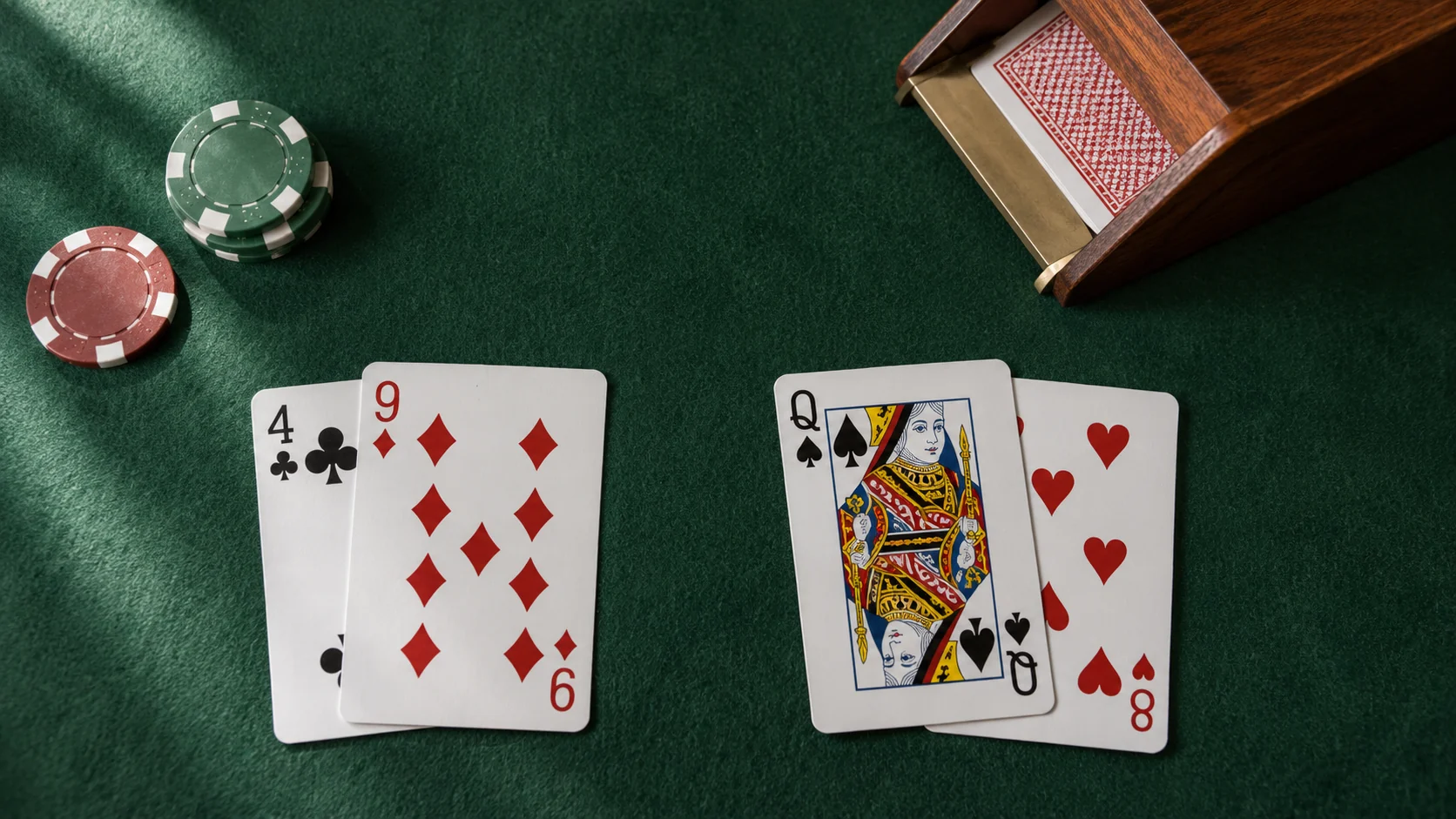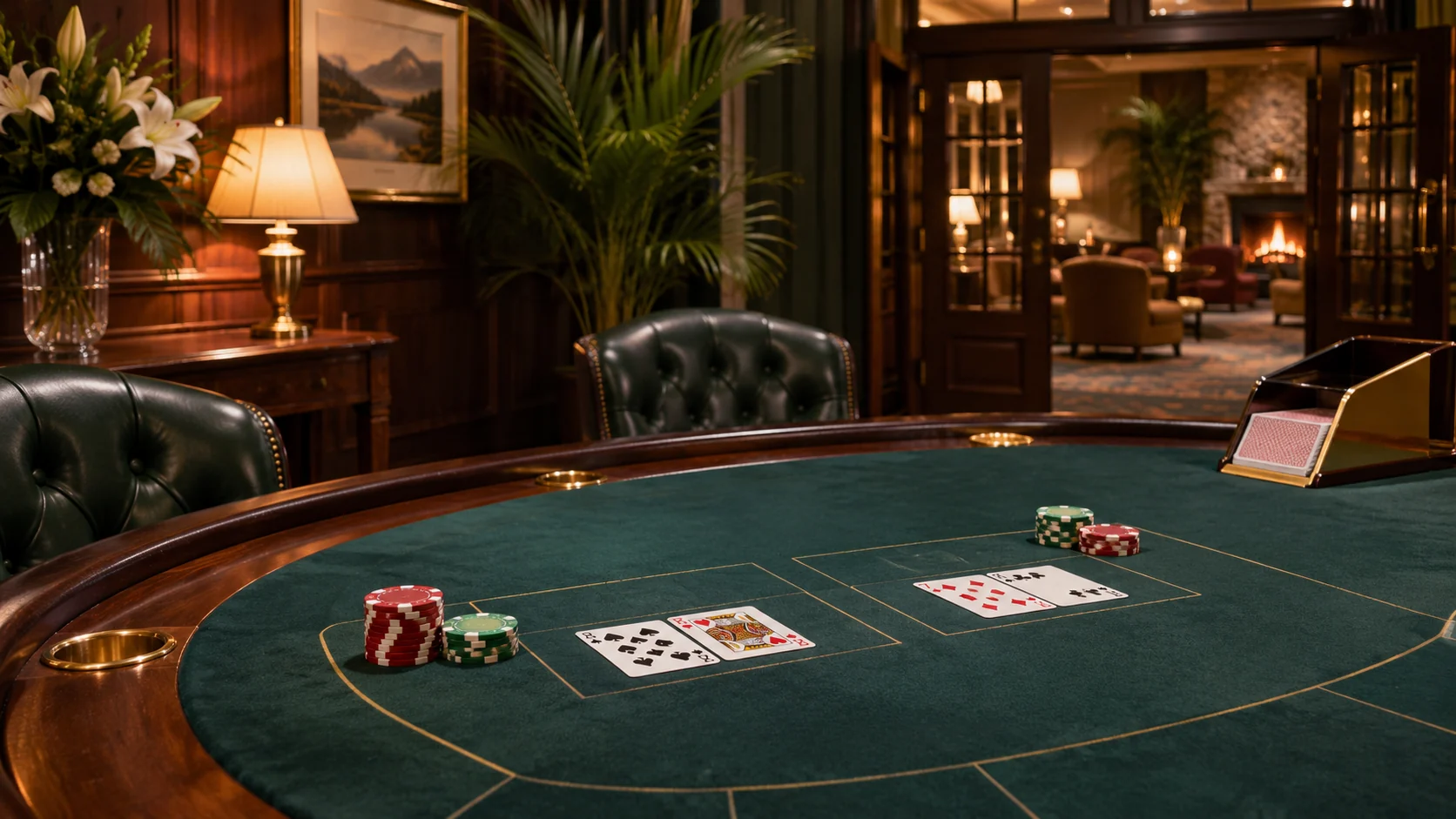
Baccarat is a casino card game built around a simple question: will the Player hand, the Banker hand or neither finish closest to nine? The dealer deals the cards, a fixed set of rules determines whether a third card appears, and the result settles the bet. In standard eight-deck Punto Banco, the Banker bet has a 1.06% house edge after its usual 5% commission, compared with 1.24% for Player and 14.36% for a Tie paying 8:1. None of those bets has a positive long-run expectation.
The names cause one common misunderstanding. “Player” does not mean the cards belong to the person placing the wager, and “Banker” does not necessarily mean the casino. Both are named hands on the table. Anyone at the table can back either outcome, subject to the game's betting rules.
How to play baccarat
The widely played version is Punto Banco , also called punto banco baccarat . The dealer runs each round, often called a coup , from a shoe containing several standard 52-card decks. Eight decks are a common configuration; tables using six or another number can have slightly different probabilities.
- Place a wager. Betting areas are labelled Player, Banker and Tie. A table may also offer optional side bets. The minimum and maximum stake are set by the venue or game.
- Two hands are dealt. The Player and Banker hands receive two cards each. The cards belong to the two table positions, not to individual bettors.
- The totals are calculated. Each hand is worth between zero and nine, even when the printed card values add to more than nine.
- The drawing rules are applied. A natural eight or nine stops further drawing. Other totals can require the dealer to give the Player hand or Banker hand a third card.
- The bets are settled. The higher final total wins. Equal totals create a Tie, also called a stand-off. On a conventional table, main Player and Banker wagers are returned when the hands tie.
Baccarat card values and scoring
| Card | Points |
|---|---|
| Ace | 1 |
| 2–9 | Printed face value |
| 10, Jack, Queen, King | 0 |
Only the last digit of the sum counts. A seven and an eight add to 15, producing a baccarat total of 5 . A king and a seven total 7, while an ace and an eight make 9. A hand of six and four totals 0 rather than 10. The same calculation applies to two-card and three-card hands; a total above nine does not make the hand bust as it would in blackjack.
A natural is a total of eight or nine on the initial two cards. If either hand has a natural, both hands stand. A natural nine beats a natural eight; matching naturals produce a tie. No player chooses to hit, stand or double down in Punto Banco.
Banker, Player and Tie: baccarat odds, payouts and RTP
Three outcomes cover every completed hand. These probabilities assume a standard eight-deck shoe, a 5% commission on winning Banker wagers and an 8:1 payout on Tie. The win probability describes the hand's outcome; the house edge includes both winning and losing results and the payout offered by the casino.
Scroll sideways to view all columns.
| Bet | Win probability | Net win payout | House edge | Theoretical RTP |
|---|---|---|---|---|
| Banker | 45.8597% | 0.95:1 | 1.0579% | 98.9421% |
| Player | 44.6247% | 1:1 | 1.2351% | 98.7649% |
| Tie | 9.5156% | 8:1 | 14.3596% | 85.6404% |
On a NZ$10 winning Banker wager, the net profit is NZ$9.50 and the total returned is NZ$19.50 including the original stake. A winning NZ$10 Player wager returns NZ$20, including NZ$10 profit. A winning NZ$10 Tie at 8:1 returns NZ$90 in total. A higher possible payout is not the same as a better-priced bet.
The Banker hand wins slightly more often because its third-card rule uses information about the Player's draw. Even after the commission, standard Banker has a marginally lower house edge than Player. The difference is small: roughly 18 cents in theoretical loss per NZ$100 staked. A Banker wager is still a losing proposition over sufficient repeated play.
What house edge and return to player really mean
House edge is the mathematical average loss expressed as a percentage of total money wagered, not the percentage of sessions or hands a person must lose. Return to player (RTP) is the complementary long-run return under a particular ruleset: 100% minus the house edge. Calling a game “98.94% RTP” without identifying the Banker bet and its commission omits a necessary condition.
One hundred NZ$10 bets create NZ$1,000 of total turnover, even if the same bankroll funds multiple rounds. At the standard house edges, the expected losses on that turnover are about NZ$10.58 on Banker , NZ$12.35 on Player and NZ$143.60 on Tie. The numbers are averages across vast numbers of outcomes, not predicted results for a particular sequence of 100 hands. Actual sessions may end ahead or lose much more.
A Tie paying 9:1 rather than 8:1 improves its eight-deck house edge to about 4.84%. It remains considerably more expensive in theoretical terms than either standard main bet. Payout conditions must be read alongside the table's odds; an unusually large prize figure is not enough to judge value.
When does baccarat draw a third card?
The third-card procedure is automatic in Punto Banco. Neither the person who wagered on Banker nor the person who backed Player controls the draw. The sequence follows these rules after the first two cards:
- If either hand is a natural eight or nine, both stand and the result is decided.
- Otherwise, Player draws on totals 0–5 and stands on 6–7.
- If Player stands on 6 or 7, Banker draws on 0–5 and stands on 6–7.
- If Player draws a third card, Banker's action follows the fixed third-card rule.
Scroll sideways to view all columns.
| Banker's initial total | Banker draws if Player's third card is | Otherwise |
|---|---|---|
| 0, 1 or 2 | Any value | : |
| 3 | 0–7 or 9 | Stands on 8 |
| 4 | 2–7 | Stands |
| 5 | 4–7 | Stands |
| 6 | 6 or 7 | Stands |
| 7 | Never | Stands |
Suppose Player starts with a five, draws an eight and finishes on three. If Banker's first two cards total three, Banker stands rather than taking another card. If the same Player had drawn a seven, Banker would draw. The difference follows the printed rule, not a dealer's judgement.
The dealing shoe, cut card and shuffle procedure govern how cards enter play. A discarded card, a dramatic reveal or a player's lucky seat does not override the drawing table. Casino staff may use a croupier or dealer to manage chips, announce totals and settle wagers; the underlying rules remain mechanical.
Which baccarat version is being offered?
Labels such as “classic”, “mini” and “no commission” are not interchangeable. The most useful distinction is between presentation changes, which often leave the mathematics intact, and payout-rule changes, which can alter the house edge.
Scroll sideways to view all columns.
| Format | What changes | What to verify |
|---|---|---|
| Punto Banco | Fixed third-card rules; standard reference game | Number of decks, Banker commission, Tie payout |
| Mini Baccarat / Midi Baccarat | Table size, dealing arrangements, handling and limits | Whether the ordinary Punto Banco payout rules apply |
| No-Commission / Super 6 | Winning Banker six commonly pays only half | The exact exception to even-money Banker wins |
| EZ Baccarat | Banker wins usually pay 1:1, but a winning three-card seven pushes | The special Banker result and related side bets |
| Speed Baccarat | Shorter betting window and more rounds per hour | Actual pace, stake limits and payout rules |
| Squeeze Baccarat | Cards are revealed slowly or handled for suspense | Whether this is only a presentation change |
| Lightning / multiplier baccarat | Extra multiplier mechanics or altered payment structures | Game-specific RTP, fees and multiplier conditions |
Why “no commission” can cost more
The term no commission sounds better than a 5% deduction from a win. Under a common version, winning Banker bets pay 1:1 except when Banker wins with a total of six; that outcome pays just 0.5:1 . The eight-deck Banker house edge under this rule is about 1.46% , higher than the standard 1.06%. Player retains an edge of about 1.24% if its rules are unchanged, making Player the lower-edge main wager at that particular table.
Christchurch Casino describes both commission and non-commission baccarat and explicitly identifies the Banker-six half-payment rule. A different commission-free product, EZ Baccarat , makes a winning Banker three-card seven a push. That version has a Banker edge of about 1.02% with eight decks. The table name alone cannot establish which rule has been implemented.
Other historical forms: Chemin de Fer and Baccarat Banque
Chemin de Fer and Baccarat Banque belong to baccarat's older family of games. Unlike Punto Banco, these versions give participants a more active role in banking or drawing decisions, and the banker arrangement differs. Rules, commission and player decisions require separate treatment. The European casino image popularised by James Bond is closely associated with these historical forms; modern electronic baccarat usually follows fixed-rule Punto Banco instead.
Live dealer, online RNG and mobile baccarat
A live dealer game broadcasts real cards dealt by a human dealer from a studio or casino table. An RNG baccarat game uses a random number generator to determine its digital deal. Mobile layouts may display betting chips, a countdown, a game history panel and dealer video on an iPhone, Android phone, tablet or desktop browser.
Names such as Evolution , Pragmatic Play Live and Playtech are associated with live-casino software. A supplier's name, an HD stream or a “VIP” label does not reveal whether its specific baccarat table uses a commission, a Banker-six exception or a multiplier fee. Slow card reveals in Squeeze Baccarat change the presentation, not the chance of a nine under unchanged rules. Shorter rounds in Speed Baccarat can increase the money wagered per hour even if the edge per bet stays constant.
Games called Dragon Tiger and Bac Bo borrow elements of the Banker-versus-Player presentation but are separate games: Dragon Tiger compares single cards, while Bac Bo uses dice. Their pay tables and house edges must not be taken from standard baccarat.
Baccarat side bets: attractive payouts, different mathematics
A side bet pays for a particular card pattern or special result rather than merely backing Player or Banker. Its wager is usually settled independently of the main bet. The menu can change between a land-based table, a live stream and a digital game.
- Player Pair and Banker Pair: the first two cards on the named hand have matching ranks. In an eight-deck game, an 11:1 payout on one named pair has a house edge of about 10.36% .
- Either Pair, Any Pair and Perfect Pair: different ways of defining matching opening cards; Perfect Pair generally requires identical rank and suit. The covered hands and posted payout determine the value.
- Big and Small: predict whether a round will use five or six cards (Big) or only four cards (Small). These bets concern the number of cards dealt, not which hand wins.
- Dragon Bonus: pays on specified winning margins or qualifying natural outcomes under its own pay table. The Player and Banker versions need not have the same house edge.
- Dragon 7 and Panda 8: special outcomes associated with EZ Baccarat. Dragon 7 involves a Banker win with a three-card seven; Panda 8 involves a Player win with a three-card eight.
- Super 6, Red/Black and other proprietary bets: special score or card-colour conditions with payouts that vary by game design.
Big prizes on a pair, Dragon Bonus or a special six do not establish good odds. Side bets often carry materially higher house edges than the two main wagers. The precise definition, payout and theoretical return are needed before comparing them. Claims that all “baccarat bets” share a 98% or 99% RTP are incorrect.
Do baccarat betting strategies work?
Under fixed Punto Banco rules, the only recurring decision is which bet to make and how much to stake . No betting progression changes the probability of the cards or cancels the house edge.
Flat betting keeps the stake constant and makes total exposure easier to monitor. Martingale doubles the wager after losses, rapidly increasing the amount at risk; a limited bankroll or a table maximum ends the progression before any promised recovery. Paroli increases stakes after wins instead. Fibonacci , Labouchere and d'Alembert apply other sequences of stake changes. Systems such as 1-3-2-6 or 1-3-2-4 also rearrange when larger wagers occur. All of them change the distribution and timing of losses, not the expected return on each unit wagered.
Choosing Banker on a standard commission table lowers the expected cost relative to Player or Tie. It cannot make a run of losses impossible. At a Banker-six half-payment table, the same rule of thumb fails because Player has the lower house edge. Bet selection has to follow the actual payment conditions.
What do baccarat scoreboards and roadmaps predict?
A physical scoreboard or a live-game history panel records previous results, often using red for Banker, blue for Player and green for Tie. The Bead Plate lists hands in sequence. The Big Road arranges Banker and Player results into streaks and switches. The derived Big Eye Boy , Small Road and Cockroach Pig compare patterns in the Big Road rather than directly identifying the next winner.
A long Banker streak and a run of alternating outcomes, often called a chop , are descriptions of past cards. Neither forces the next hand to favour Player or Banker. Dealt cards leave a finite shoe, so its remaining composition changes slightly, but the familiar road patterns do not provide a dependable forecasting method. The gambler's fallacy is the belief that a result becomes due simply because the opposite result has appeared repeatedly.
Card counting is a different idea from following a roadmap. Changes in the cards remaining in the shoe can alter precise probabilities, yet applying that information is difficult and does not make ordinary baccarat a reliably profitable game. A cut card and shuffling procedure also limit how much of a shoe remains available for observation.
How to compare two baccarat tables
Two tables displaying the same three large betting circles can have different financial terms. Payouts, wager sizes and pace distinguish a genuine rules change from a cosmetic variation:
- Read the Banker payment. Is it 0.95:1, 1:1 except on Banker six, or a three-card-seven push? This single line can reverse the comparison between Banker and Player.
- Read the Tie payment. A quoted 8:1 or 9:1 return changes Tie's expected cost significantly, despite identical card-scoring rules.
- Identify the shoe and game type. Six or eight decks, RNG, live dealing, and specialty side bets may require different probability tables.
- Compare minimum and maximum wagers. A NZ$5 minimum used for 100 hands is NZ$500 of betting turnover, even if the starting bankroll is smaller.
- Consider the pace. Speed tables can multiply the number of bets placed during a fixed period. A lower minimum is of little use if the chosen pace encourages more total wagering.
- Distinguish game rules from account terms. A site displaying balances in NZ dollars may still impose payment processing conditions, withdrawal limits or special exclusions for table games in its bonus wagering terms.
A free or demo baccarat mode, where available, can demonstrate scoring, chip placement and the third-card sequence without a cash wager. It does not establish that the related real-money service is authorised for New Zealand customers.
Baccarat in New Zealand: casinos, age limits and online regulation
In Aotearoa New Zealand, physical casino games operate under the Gambling Act 2003 and approved table-game rules. The Department of Internal Affairs (Te Tari Taiwhenua) lists baccarat rules incorporating mini and midi baccarat. A person must be at least 20 years old to enter a casino gambling area or take part in casino gambling.
Online casino gambling follows a separate legal framework. The Online Casino Gambling Act 2026 came into force on 1 May 2026, setting up a New Zealand licensing regime. As at 12 November 2026 , the Department of Internal Affairs describes a transitional market: online casino advertising to people in New Zealand is prohibited, the licensed system is not expected to be fully operational until 2027, and providers without a qualifying licence application must leave the market from 1 December 2026. A licence issued overseas is not the same as approval under New Zealand's new framework.
The Act requires licensed online casino operators to verify that customers are 18 or older . This differs from the age-20 rule for physical casino gambling areas. Rules governing provider eligibility, licence status and consumer protections can change during the transition. Current regulatory information is published by the Department of Internal Affairs for online casino customers .
Baccarat is a casino game rather than a form of sports or racing betting. Its rules and regulatory category should not be confused with TAB NZ or the separate rules for racing and sports wagering.
Bankroll limits and gambling harm
With every wager having a theoretical house advantage, a session budget is a limit on possible loss, not a route to a guaranteed result. A fixed entertainment amount, a maximum time, a separate record of total stakes and a refusal to chase losses keep the financial commitment visible. Repeatedly recycling a small balance through the same table can create much more turnover than the amount first deposited.
Financial pressure, borrowing to gamble, hiding losses and feeling unable to stop are signs that play has ceased to be recreational. Safer Gambling Aotearoa provides confidential local assistance. New Zealand's free, 24-hour Gambling Helpline is 0800 654 655 ; free text support is available on 8006 . Information and support services are available through safergambling.org.nz .
Frequently asked questions about baccarat
Can several people bet on the same baccarat hand?
Yes. A Punto Banco table may have several people betting on Banker, Player or Tie at once. They are wagering on the same two dealt hands; each person's chips are settled individually according to the outcome and their chosen bet.
When is Banker commission charged?
At a conventional 5% commission table, the deduction applies to winning Banker bets, not every bet placed. Some physical tables account for commission separately and settle it under the venue's procedures. A tied hand normally returns the Banker stake without a winning commission.
Can a bet be changed once cards have been dealt?
Standard baccarat betting closes before the deal begins. A live dealer countdown marks the point at which stakes are locked. Digital games apply the same restriction through their interface. Changes after that point are not part of an ordinary round.
Can baccarat be played without wagering money?
Some digital games provide a demonstration or play-money setting. It can familiarise a newcomer with the layout and scoring, but offers no real-money payout. Availability of a demo does not indicate the licensing or regulatory status of a gambling operator.
How is baccarat different from blackjack, roulette or pokies?
Blackjack involves decisions about drawing and standing; standard Punto Banco decides those actions automatically. Roulette settles bets through a wheel, while pokies use slot-game outcomes. The house edge and RTP depend on the particular game and wager rather than the broad label “casino games”.