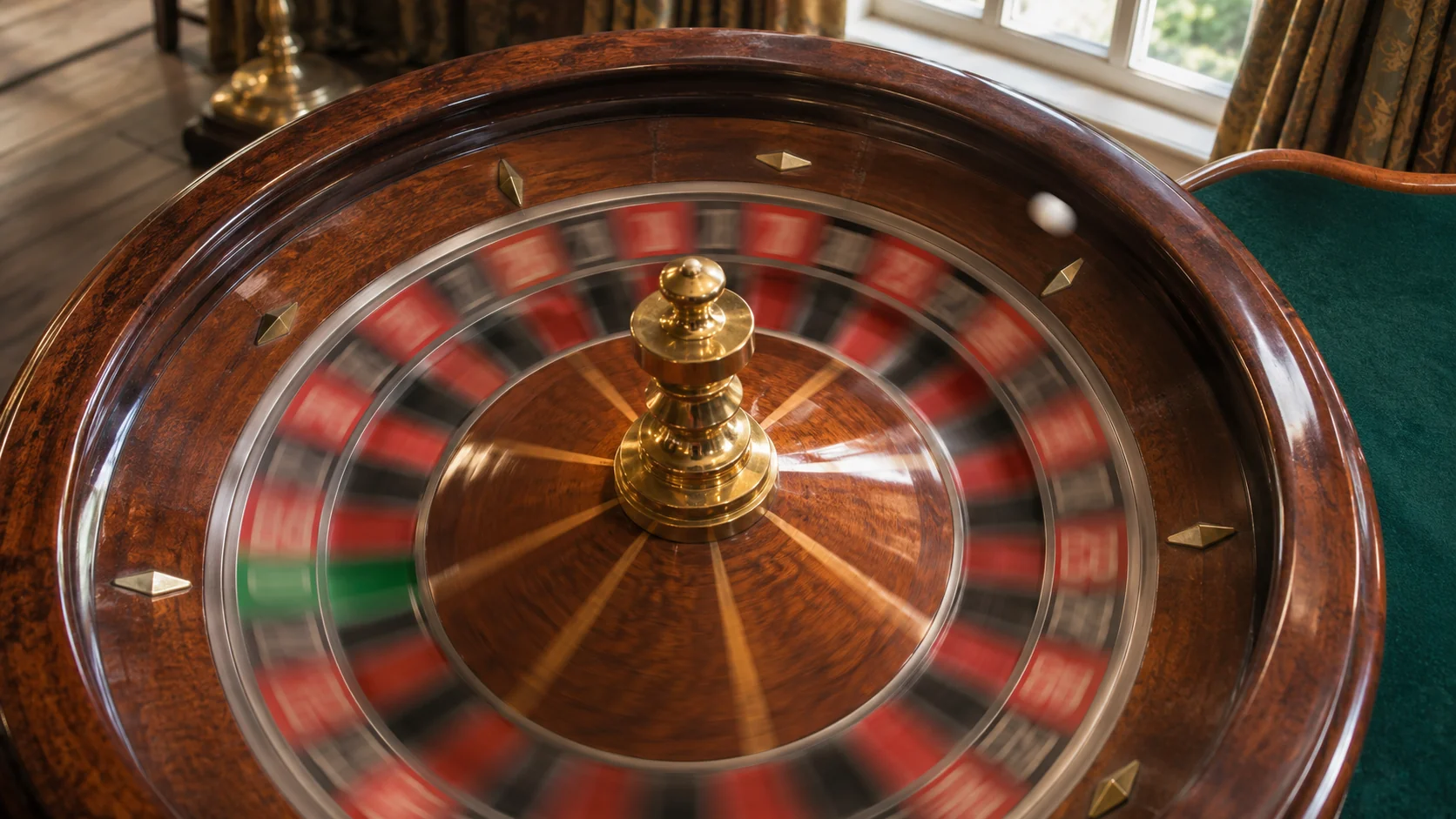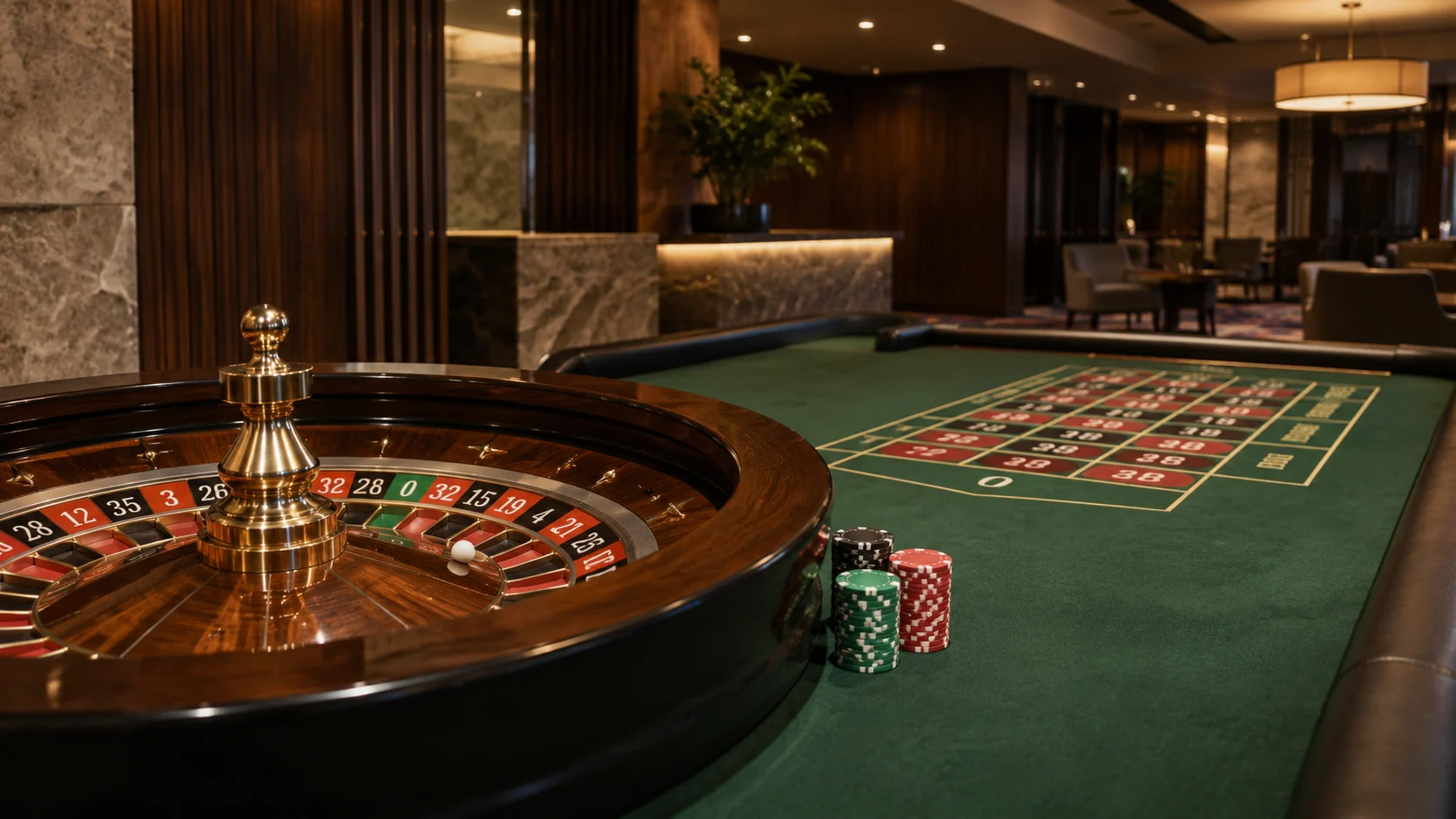
In roulette, a small ball settles in one numbered pocket of a spinning wheel. Players place chips on individual numbers, colours or groups of numbers on the table layout. The landing pocket settles every wager for that spin, using the game's published paytable.
The wheel changes the mathematics more than any betting pattern. Standard European roulette has one green zero and a 2.70% house edge. American roulette has a second green pocket, 00, raising the edge on standard bets to 5.26%. A single-zero French table offering la partage brings it down to 1.35% on eligible even-money bets. No staking system changes these figures.
How does roulette work?
The wheel and the betting layout are separate. Numbers 1 to 36 split evenly between red and black. Zero is green; a double-zero wheel adds a green 00. Neither green pocket counts towards red/black, odd/even or low/high (1–18 and 19–36).
- Betting opens. Players select a chip value and place chips on the printed numbers or outside betting areas. Multiple bets can be placed on one spin, subject to the table limits.
- The wheel spins. The dealer, also called the croupier , spins the wheel and releases the ball in the opposite direction. Electronic and online versions produce and display their results through the mechanism described in their game rules.
- Betting closes. The dealer calls “no more bets”, or a digital countdown locks the layout. Late wagers are not accepted.
- The result is marked. The ball settles in a pocket. At a physical table, the dealer places a marker, often called a dolly , on the winning number.
- Bets are settled. Losing chips are cleared and winning wagers are paid at their listed odds. The next round begins when the layout is available again.
At many physical tables, colour-coded roulette chips identify each player's wagers. The chips receive an agreed value when a player buys in. Christchurch Casino requires players to exchange them for ordinary casino chips before leaving. Digital tables show chip denominations and the combined stake on screen.
European, American and French roulette: which wheel is different?
The familiar versions all carry numbers 1–36. Add a green pocket, though, and a bet on red becomes less likely to win, even when the listed payout stays at 1:1.
Scroll sideways to view all columns.
| Version | Pockets | Zero pockets | House edge | Theoretical RTP |
|---|---|---|---|---|
| European roulette | 37 | 0 | 2.70% | 97.30% |
| American roulette | 38 | 0 and 00 | 5.26% | 94.74% |
| French roulette with la partage | 37 | 0 | 1.35% on even-money bets | 98.65% on those bets |
| Triple-zero roulette | 39 | 0, 00 and 000 | 7.69% on standard bets | 92.31% on those bets |
French roulette does not always have a 1.35% edge. That lower figure applies only to eligible even-money bets when la partage is offered. Other French bets ordinarily retain the 2.70% single-zero edge. The American five-number top line has an even higher edge of 7.89%.
A European wheel has a fixed sequence of numbers rather than numerical order; wheel neighbours matter for racetrack bets. The rectangular betting layout is different. Its three columns contain twelve numbers each, with separate areas for dozens, colours, parity and ranges.
Roulette bets, payouts and winning probabilities
Inside bets cover one number or a small cluster on the numbered grid. Outside bets cover larger sets, including colours, dozens and columns. The smaller the group, the bigger the payout when it wins. On an ordinary single-zero wheel, neither approach improves the 2.70% house edge.
Scroll sideways to view all columns.
| Bet | Numbers covered | Net payout odds | Chance of winning |
|---|---|---|---|
| Straight up ( en plein ) | 1 | 35:1 | 2.70% |
| Split ( cheval ) | 2 | 17:1 | 5.41% |
| Street | 3 | 11:1 | 8.11% |
| Corner ( carré ) | 4 | 8:1 | 10.81% |
| Six line / double street | 6 | 5:1 | 16.22% |
| Dozen or column | 12 | 2:1 | 32.43% |
| Red/black, odd/even, 1–18/19–36 | 18 | 1:1 | 48.65% |
A straight-up chip covers one number; a split sits between two touching numbers. One row of three is a street , four meeting squares make a corner , and two adjacent rows form a six line . Some zero-side layouts add a three-number trio or a four-number first four wager. The precise chip position comes from the table's diagram.
Outside options include three dozens (1–12, 13–24, 25–36), three columns , low/high (1–18 or 19–36), odd/even and red/black . Dozens and columns cover twelve pockets each; even-money bets cover eighteen. Zero is never included.
The American five-number bet combines 0, 00, 1, 2 and 3. It pays 6:1 and wins on 5 of 38 pockets (13.16%). Its 7.89% house edge is worse than the edge on standard double-zero bets, so the bet cannot be treated as an ordinary corner or six line.
What do roulette payouts mean in NZ dollars?
Payout odds describe profit, with the winning stake returned separately. A NZ$2 straight-up chip at 35:1 pays NZ$70 profit, or NZ$72 including the stake. A NZ$5 red bet at 1:1 pays NZ$5 profit and returns NZ$10.
Take NZ$5 on red and NZ$2 on number 7 (a red number). If 7 lands, the bets return NZ$10 and NZ$72: NZ$82 back from NZ$7 staked, a net profit of NZ$75. Any other red pocket returns NZ$10 on red but loses the NZ$2 chip, leaving NZ$3 profit. Zero loses both chips: NZ$7. The combined stake, not the largest payout, determines the net result.
Roulette odds, house edge and the cost of a session
Red wins on 18 of 37 European pockets: 18 ÷ 37 = 48.65% . On an American wheel it wins on 18 of 38: 18 ÷ 38 = 47.37% . Zero, and 00 where present, are why red/black is not a true 50/50 wager.
The house edge is the casino's theoretical share of all money wagered across many spins. Return to player (RTP) is the remaining percentage. Neither predicts the result of one visit or guarantees how much of an individual stake comes back.
Scroll sideways to view all columns.
| Rule set | Expected loss per NZ$100 wagered | What the figure assumes |
|---|---|---|
| Single-zero European | NZ$2.70 | Standard payouts |
| Double-zero American | NZ$5.26 | Standard bets; excludes the five-number special |
| Single-zero with la partage | NZ$1.35 | Even-money bets only |
Twenty spins at NZ$5 create NZ$100 of turnover , even if a player started with NZ$20 and reused winnings. Expected loss is calculated from the entire NZ$100 wagered, not the deposit. A single session can finish far above or below the long-run average.
Game speed changes exposure. Sixty spins at NZ$5 create NZ$300 in total bets. That carries an expected loss of about NZ$8.11 on European roulette, compared with NZ$15.79 on American roulette. Fast digital rounds reach the same turnover sooner. They do not reduce the house edge.
La partage, en prison and French racetrack bets
La partage and en prison are exceptions to ordinary zero settlement in French-style roulette. Under la partage , zero costs half the stake on an eligible even-money wager. A NZ$10 red bet therefore gets NZ$5 back instead of losing NZ$10. The resulting edge on those bets is 1.35% at a single-zero table.
Under en prison , an eligible even-money wager stays on the table after zero until a later spin decides whether the stake is recovered or lost, according to that game's rules. Neither special rule is automatic. A “French” label alone does not establish how the table handles zero.
Some European and French tables also have a racetrack for selecting neighbouring pockets on the wheel, not neighbouring squares on the betting grid. The grouped placements are known as announced bets or call bets :
- Voisins du zéro covers 17 pockets in the wheel sector around zero, using a prescribed group of split and trio placements.
- Tiers du cylindre covers 12 pockets opposite the zero section, commonly through six split bets.
- Orphelins covers the eight pockets outside the Voisins and Tiers sectors.
- Jeu zéro focuses on seven pockets close to zero using a smaller combination of bets.
- Neighbour bets select a central pocket and a specified number of wheel neighbours on either side; final bets group numbers by their last digit.
Racetrack selections combine ordinary wagers, often over several chips. They do not change the house edge, and their total stake may exceed one chip on the grid. A snake bet traces a winding pattern on the layout; a full-complete bet combines available inside bets involving one number. Neither combination is universal.
Live dealer, online RNG and electronic roulette
The same single-zero odds can come from a casino wheel, a live-streamed table or an online game. The practical differences lie in pace, equipment and betting controls.
Scroll sideways to view all columns.
| Format | How the result is produced | What changes for the player |
|---|---|---|
| Land-based table roulette | Physical wheel and ball controlled by a croupier | Shared layout, table-specific chips, dealer pace and floor rules |
| Online RNG roulette | Software random number generator produces the result | Digital chip controls, rapid rounds, mobile access and sometimes demo mode |
| Live dealer roulette online | Physical wheel in a streamed studio with a live croupier | Betting timer, video feed, possible chat and shared table limits |
| Electronic or rapid roulette | Physical wheel linked to individual betting terminals, or an authorised automated device | Personal screen for bets and payouts; format depends on venue equipment |
A random number generator (RNG) produces the outcome in software roulette; physical wheels use a ball. The pocket count and paytable set the odds; testing and regulatory controls address whether the game delivers those odds fairly. A spinning animation cannot establish that software has been tested.
Online live-dealer tables may have high-definition video, a countdown timer, chat and a racetrack interface. Automated and speed formats shorten the pause between rounds. Christchurch Casino has described Rapid Roulette terminals linked to a live wheel. A faster or more elaborate display does not alter the declared odds.
Speed roulette, Lightning Roulette and other variations
Speed Roulette , Auto Roulette and First Person Roulette chiefly change the pace or presentation. An automatic wheel runs without a conventional table-side dealer; a first-person version uses a rendered viewpoint. Mini Roulette may have fewer pockets, while Double Ball Roulette uses two balls. Once the mechanics or payout schedule changes, the standard European RTP no longer tells the whole story.
Multiplier roulette adjusts payouts, even on a single-zero wheel. In Evolution's Lightning Roulette , randomly chosen Lucky Numbers receive enhanced straight-up multipliers, while ordinary straight-up wins pay below 35:1. Pragmatic Play's Mega Roulette uses Mega Multiplier on selected results. The advertised multiplier applies only when its conditions are met; it does not make the selected number more likely to land. Each game needs its own paytable and RTP.
Menus may list European Roulette , American Roulette , French Roulette , Live Roulette , VIP Roulette and 3D Roulette . The label cannot reveal whether the wheel has 37 or 38 pockets. Zero rules, altered payouts, table limits and the published RTP distinguish the games.
Do roulette strategies improve the odds?
Roulette offers no skill decision like drawing another card in blackjack. On a fair wheel or RNG that treats each spin separately, every pocket has a fixed probability on the next spin. A system changes how much a player stakes, not where the ball lands.
Martingale doubles the wager after each loss, commonly on red/black. Starting at NZ$5, six losses cost NZ$5 + NZ$10 + NZ$20 + NZ$40 + NZ$80 + NZ$160 = NZ$315 . The next bet must be NZ$320. A table limit or depleted bankroll can end the progression before a win, and a recovered sequence still faces the same house edge.
Fibonacci and D'Alembert increase stakes in smaller steps. Labouchere follows a number sequence; reverse Labouchere and Paroli raise stakes after wins. These progressions change the pattern of gains and losses, not the odds of a 37-pocket or 38-pocket wheel. Flat betting leaves the chip value unchanged, making spending easier to track without promising a better return.
Hot numbers , cold-number lists, spin histories and colour streaks describe what has already happened. On a separate European spin, number 17 still has a 1-in-37 chance, whether it landed a moment ago or not for an hour. Thinking a colour is “due” is the gambler's fallacy . Covering more numbers can increase how often some bet pays out, but it also puts more chips at risk.
“Wheel bias”, dealer signatures and spin-timing patterns are not reliable edges on fair, maintained equipment. Casinos apply controls to physical wheels; software outcomes require testing against the game rules. No roulette system guarantees a win.
What to check before comparing roulette tables
Tables that look alike can differ in cost, minimum stakes, round speed and settlement rules. A previous-results chart tells less about those differences than the actual rules and paytable.
- Wheel and zero rules: 37, 38 or 39 pockets; whether la partage applies to even-money bets; any special zero arrangement.
- Paytable and RTP: standard 35:1 straight-up returns or modified payouts for Lightning, Mega, mini and other variations.
- Table limits: minimum and maximum chips, limits per inside/outside bet, and the combined maximum for a spin or sector bet.
- Session pace: time to place a wager, time between rounds and whether the interface encourages repeated or automatic betting.
- Actual cost in NZD: the currency of the gaming balance, any conversion spread, payment fees and the total amount wagered across simultaneous bets.
- Rules and account conditions: result disputes, identity verification, withdrawals and any restriction that affects a particular game.
Roulette bonuses have terms separate from the game's odds: wagering requirements , eligible-game contribution percentages, minimum odds, maximum qualifying stakes, deadlines and withdrawal caps. A NZ$100 bonus is not NZ$100 of unrestricted cash. Live roulette can count for little or nothing towards a playthrough target. The game rules and bonus terms need separate checks.
A free-play or demo roulette mode is useful for learning chip placement without risking cash, not for forecasting future numbers. New Zealand's minimum standards for licensed online platforms require disclosure before paid play if the free version has different odds or RTP from its real-money equivalent.
Roulette in New Zealand: venues, age limits and online rules
New Zealand's land-based casinos include SkyCity Auckland , SkyCity Hamilton , SkyCity Queenstown , Christchurch Casino and Grand Casino Dunedin . Wheel types, table minimums and opening times vary, and venue names alone do not establish which roulette versions are available. SkyCity describes carded play and identification requirements for some tables in its published table-game information . The Department of Internal Affairs (DIA) casino table-game rules include roulette rules updated in May 2025.
Age rules differ between physical and regulated online casinos. Players must be 20 or older to enter gaming areas in New Zealand's land-based casinos, as stated in SkyCity Auckland's age-limit policy . Under the Online Casino Gambling Act 2026 , licensed online operators must take reasonable steps to ensure customers are at least 18 . The two age thresholds apply to different settings.
Online casino regulation, 12 November 2026: The Online Casino Gambling Act took effect on 1 May 2026. Licences were expected to begin in early 2027. Online providers active in New Zealand on 1 May 2026 may operate under transitional rules, but those without a licence application must leave the market from 1 December 2026 . Existing providers with applications under consideration may continue under the statutory exemption until a decision, subject to its end date. Online casino advertising remains prohibited during the transition. The DIA publishes current information for players and implementation updates .
The regulator's public register will show which online casino operators hold a New Zealand licence once licences are issued. The 2026 minimum standards cover access to rules and RTP, RNG integrity, account authentication, deposit and time limits, reminders, breaks, self-exclusion and live-dealer controls. Neither an NZD balance nor a familiar name proves that an online site holds a New Zealand licence.
Keeping roulette spending within a fixed limit
The stake for one spin is the sum of all chips placed. After losing NZ$5, a further NZ$10 bet puts the session NZ$15 down unless a later payout offsets it. Gross winning payouts can look encouraging while the running net result remains negative.
A money limit caps losses; a time limit curbs repeated small bets. They protect against different risks, especially when rounds come quickly. Chasing losses with bigger stakes, borrowing to gamble, hiding spending or neglecting commitments are warning signs. Casino self-exclusion and breaks in play exist through venue policies; licensed online operators must provide prescribed harm-prevention controls.
New Zealand's Gambling Helpline offers free, confidential help at any hour on 0800 654 655 , or by free text to 8006 . Support extends to friends and whānau affected by gambling. Safer Gambling Aotearoa explains warning signs and local support options.
Roulette questions people ask
Is roulette mainly luck or skill?
Chance decides the landing pocket. Knowing the layout, zero rules and correct payouts helps prevent costly errors, but not predict the result.
What is the easiest roulette bet for a beginner to understand?
Red/black and odd/even each cover 18 numbers and pay 1:1. Zero (and 00 where present) keeps the win probability below 50%.
What happens when the ball lands on zero?
A straight-up zero bet pays 35:1 on a standard wheel. Ordinary red/black, odd/even and high/low bets lose, except where la partage or en prison applies to eligible wagers.
Can roulette be beaten by tracking previous numbers?
No. On a fair wheel, a streak of black does not make red more likely next time. Every European pocket has a 1-in-37 chance each spin.
Does 97.30% RTP mean a player gets NZ$97.30 back from NZ$100?
No. The 97.30% figure is a long-run average across wagers, not a guaranteed NZ$97.30 payout. An individual NZ$100 session may lose everything or finish ahead.
Can roulette be played for free?
Some digital roulette games offer demo credits that cannot be cashed out. A demo helps with chip placement, but its paytable does not replace the rules for real-money play.