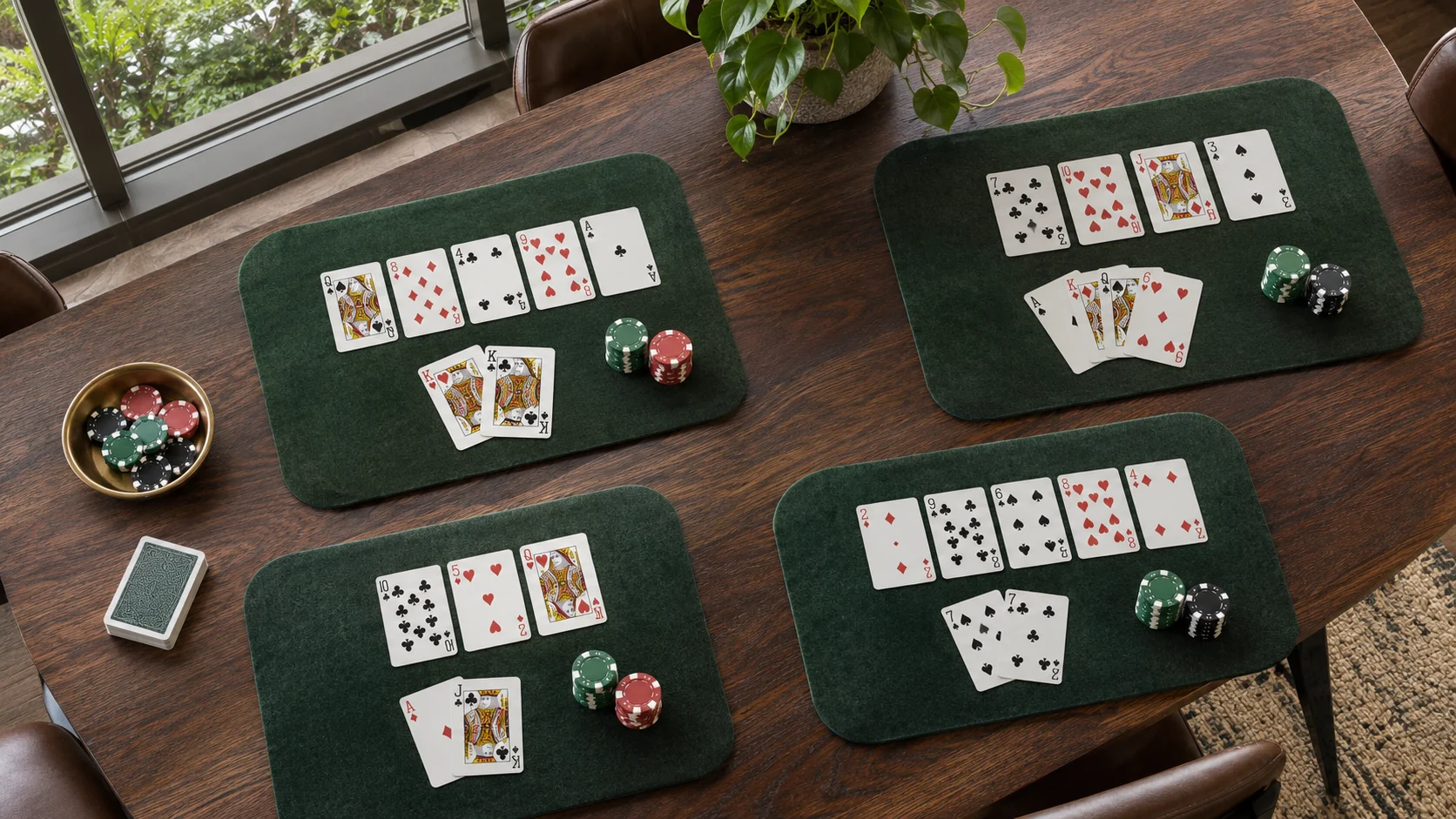
Hold’em, Omaha and Stud are different games, not different stake levels. Texas Hold’em lets players combine private cards with a shared board; Omaha restricts which private cards count. Stud shows some of an opponent’s cards, draw games let players replace cards, and lowball turns the usual hand rankings upside down. For a New Zealand poker club session, the relevant questions are which rules apply, how betting works and what the event permits.
Traditional poker falls into three broad families: community-card poker , stud poker and draw poker . Mixed games rotate through several variants. High, lowball and hi-lo determine the winning hand; no-limit, pot-limit and fixed-limit govern bets. Cash games, tournaments and six-max tables describe formats rather than card rules.
Poker variants compared
Scroll sideways to view all columns.
| Variant | Cards and layout | How a hand wins | Rule to remember |
|---|---|---|---|
| Texas Hold’em | 2 hole cards; 5 community cards | Best five-card high hand | Any combination of private and board cards |
| Pot-Limit Omaha (PLO) | 4 hole cards; 5 community cards | Best five-card high hand | Exactly 2 hole cards and 3 board cards |
| Omaha Hi-Lo (Omaha 8) | 4 hole cards; 5 community cards | High hand and qualifying low split the pot | Exactly 2 + 3 for each half; low must qualify |
| Five- or Six-Card Omaha | 5 or 6 hole cards; 5 community cards | Best high hand, or hi-lo under its rules | Still use exactly 2 hole cards |
| Short Deck (6+ Hold’em) | 2 hole cards; 5 community cards; 36-card deck | Modified high-hand rankings | Cards 2–5 removed; confirm the ranking sheet |
| Seven-Card Stud | 7 personal cards; 4 face up | Best five-card high hand | No shared flop, turn or river |
| Razz | 7 personal cards; 4 face up | Lowest five-card ace-to-five hand | A-2-3-4-5 is best |
| Stud Hi-Lo (8 or Better) | 7 personal cards; 4 face up | Best high and qualifying low | Low half is not always awarded |
| Five-Card Draw | 5 private cards; replacement draw | Best five-card high hand | No community cards |
| 2-7 Triple Draw | 5 private cards; up to 3 draws | Lowest deuce-to-seven hand | Aces, straights and flushes are bad for low |
| Badugi | 4 private cards; up to 3 draws | Best four-card low with different suits and ranks | A-2-3-4 in four suits is best |
| H.O.R.S.E. | Rotating five-game mix | Changes with the active game | Five separate rule sets, usually fixed-limit |
A player can win without showing a hand when every opponent folds. If two or more players remain at showdown, the variant’s rules decide which five cards count and who receives the pot.
Community-card poker: Hold’em, Omaha and Short Deck
Texas Hold’em: two hole cards and five shared cards
Each Texas Hold’em player gets two face-down hole cards . Five shared cards appear in stages: three on the flop , one on the turn and one on the river . Betting occurs preflop and after each deal. Depending on the action, players can check, bet, call, raise or fold.
At showdown, a Hold’em player uses the best five of seven available cards: both hole cards, one or neither. The dealer button establishes position, while the small blind and big blind put chips into the pot before the first deal. Acting late reveals what other players have done, though their cards remain hidden.
No-Limit Texas Hold’em (NLHE) is a familiar club starting point. Clubs New Zealand has listed an organised North Island Texas Hold’em tournament. Knowing the rules is only the start: stack size, position, opponents, pot odds and bluffs can change the right decision from one hand to the next.
Pot-Limit Omaha: four cards, but exactly two must play
Standard Pot-Limit Omaha (PLO) gives each player four private cards and uses a five-card board. Unlike Hold’em, an Omaha hand must contain exactly two hole cards and exactly three community cards . That requirement holds for straights, flushes, full houses and every other hand.
Picture four hearts on the board. In Hold’em, a single heart in your hand completes a flush. In Omaha, it does not: you need two hearts among your own cards and three on the board. Forgetting that restriction is a common source of incorrect hand reads.
Four private cards give PLO players several two-card combinations and overlapping draws. A strong straight can lose to the nuts :the best possible holding on that board. Connected cards, suits, redraws and the risk of being dominated matter more than a lone high pair. Pot-limit rules also restrict the maximum bet or raise to a pot-based amount.
Omaha Hi-Lo: a pot that can have two winners
Omaha Hi-Lo ( Omaha Eight or Better , or Omaha/8 ) can split the pot between high and low. A qualifying ace-to-five low needs five different ranks from eight down to ace; straights and flushes do not count against it. For either half, players must use exactly two hole cards with three board cards.
There may be no low winner. The board must contain at least three different cards ranked eight or lower for a qualifying low to be possible. Without one, high takes everything. Winning both halves is a scoop ; sharing the low half with another player while someone else takes high leaves each low winner a quarter of the pot, subject to odd-chip rules.
Five-Card Omaha, Six-Card Omaha and Big O
Five-Card Omaha (PLO5) and Six-Card Omaha (PLO6) add private cards without changing Omaha’s exactly-two-hole-card rule. Big O commonly means five-card Omaha hi-lo, not every five-card high-only game. Extra cards increase possible combinations, but no player may use three private cards in the final hand.
In Courchevel , a five-card Omaha relative, one flop card appears early. The exact deal and betting sequence should be set out in the house rules. These are established variants, not proof that a particular New Zealand club has them on its schedule.
Short Deck and Pineapple: familiar boards, different decisions
Short Deck , also called 6+ Hold’em , removes the 2s, 3s, 4s and 5s, leaving 36 cards. Players still have two hole cards and a shared board. Under common rules, a flush beats a full house and A-6-7-8-9 makes the lowest straight. Some house rules also change the order of a straight and three of a kind. Antes and a button blind may replace small and big blinds; the club’s ranking sheet settles any variation.
Pineapple begins with three hole cards, but players discard one before the flop. In Crazy Pineapple , they discard after the flop betting round. Both finish with two hole cards and a regular five-card Hold’em board. The timing of that discard changes the information available during early betting.
Stud poker: exposed cards replace the shared board
There is no shared board in Seven-Card Stud . Players receive two downcards and one upcard on third street , followed by face-up cards on fourth, fifth and sixth street and one final face-down card. The best five of seven cards determine the high hand.
Stud commonly starts with an ante and a forced bring-in , not Hold’em blinds. Exposed cards offer clues: if several players show cards of the rank you need, fewer remain unseen. A hidden pair and a pair showing on the table send very different signals.
Razz uses the Stud deal but awards the pot to the lowest five-card ace-to-five lowball hand. The best is A-2-3-4-5, known as the wheel . Straights and flushes do not count against a low, and there is no eight-or-better qualifier. Under standard rules, the highest exposed card posts the bring-in.
Seven-Card Stud Hi-Lo (Stud Eight or Better) has separate high and qualifying low halves. Low requires five different ranks of eight or less; if nobody qualifies, high wins the pot. Five-Card Stud is an older, shorter Stud form with exposed cards, not another name for Five-Card Draw.
Draw poker and lowball: replacing cards changes the information
Five-Card Draw gives everyone five private cards. After an opening betting round, players usually discard and replace cards, then bet again before a possible showdown. Because no board is visible, an opponent’s draw count is a clue rather than proof: one discarded card might mean a straight draw, a flush draw, two pair or a bluff.
Deuce-to-Seven Triple Draw (2-7 Triple Draw) deals five private cards and permits up to three draws. In deuce-to-seven lowball , aces rank high and straights and flushes count against you. The best hand is 7-5-4-3-2 in mixed suits , not A-2-3-4-5. No-Limit 2-7 Single Draw uses the same ranking but only one draw and a different betting structure.
Badugi starts with four private cards and normally offers three draws. A four-card Badugi needs four distinct ranks and suits. The best is A-2-3-4, one card of each suit . Any valid four-card Badugi beats a three-card hand, however low the three ranks are. That rule sets it apart from ordinary Five-Card Draw.
Lowball describes a winning-hand system , not a single deal. Razz rewards ace-to-five low hands, 2-7 Draw penalises straights and flushes, and Badugi requires four different suits and ranks. Mixing up those systems can cost a pot at showdown.
Mixed games, dealer’s choice and Chinese poker
H.O.R.S.E. rotates H old’em, O maha Hi-Lo, R azz, Seven-Card S tud and Stud E ight or Better. The traditional mix uses fixed-limit betting. At each change, players must reset their assumptions about low hands, shared cards and the right number of hole cards.
An 8-Game Mix adds Limit 2-7 Triple Draw, No-Limit Hold’em and Pot-Limit Omaha to H.O.R.S.E. In dealer’s choice , the table chooses from an agreed list for a set number of hands or an orbit. A round of each (ROE) often alternates Hold’em and Omaha. Game order, limits and the rotation point need to be agreed before play.
Chinese Poker and Open-Face Chinese Poker (OFC) use a different scoring system from Hold’em. Players arrange 13 cards into a three-card front, five-card middle and five-card back; the version’s rules govern points and royalties . Pineapple OFC is another arrangement-based game. Fouled hands and bonuses make a written scoring sheet particularly useful.
Irish Poker, Dramaha, Badacey and Badeucey may appear at home games or dealer’s-choice tables. A familiar name does not guarantee familiar rules or a place on a New Zealand club schedule; the written deal and scoring rules matter more.
Hand rankings that change between poker games
For standard high poker, the order runs from royal flush and straight flush through four of a kind , full house , flush , straight , three of a kind , two pair , one pair and high card . A royal flush is the highest straight flush. A kicker settles certain ties; suits have no ranking of their own in standard high-hand showdowns.
Scroll sideways to view all columns.
| System | Where it appears | Decisive difference |
|---|---|---|
| Standard high | Hold’em, Omaha High, Seven-Card Stud, Five-Card Draw | Full house beats flush; strongest five-card hand wins |
| Ace-to-five low | Razz; low halves of Omaha/8 and Stud/8 | Ace is low; straights and flushes do not hurt the low |
| Deuce-to-seven low | 2-7 Single Draw and Triple Draw | Ace is high; straights and flushes hurt; 7-5-4-3-2 is best |
| Badugi low | Badugi | Four different suits and ranks beat a shorter qualifying hand |
| Short Deck high | 6+ Hold’em | Flush outranks full house in common rule sets; confirm other changes |
A split pot does not mean everyone with a low-looking hand gets half. Eight-or-better lows must qualify, and ties can divide either half further. An all-in may create side pots, each settled only among eligible players. House rules determine how odd chips are awarded.
Poker variants are not the same as table formats
NLHE, PLO, turbo and bounty might appear on the same club schedule, but they describe different things. The variant sets the deal and hand ranking, the limit sets legal bet sizes, and the tournament format sets entry and payout conditions.
- No-Limit, Pot-Limit and Fixed-Limit
- No-Limit permits bets up to the chips available when action is legal. Pot-Limit caps bets and raises using the pot calculation. Fixed-Limit prescribes their sizes. NLHE and PLO combine a card variant with a betting limit; neither term defines a whole poker family.
- Cash game and tournament
- Cash-game chips have a monetary value under the table rules. Tournament players start with a defined stack, follow blind levels and compete for prizes. A freezeout has no return after elimination; re-entry and rebuy formats allow additional entries or chips under the event’s terms.
- Sit & Go, MTT, bounty and turbo
- A Sit & Go (SNG) begins when enough players register. A multi-table tournament (MTT) runs across several tables. A bounty changes the prize structure. Turbo and hyper-turbo make blind levels faster. None changes how Hold’em cards are dealt.
- Heads-up, six-max and full-ring
- At heads-up tables, two players act. Six-max seats up to six, while full-ring normally has more. Table size changes position and starting-hand decisions, not the card rules that distinguish Hold’em from Omaha.
- Fast-fold, bomb pot and run it twice
- Fast-fold speeds up movement between hands. A bomb pot uses special forced contributions and may begin postflop; a double-board bomb pot can split awards between boards. Run it twice deals remaining community cards twice after an agreed all-in. These procedures are not new poker families.
Table fees and the rake are separate from card rules. Overseas poker rooms may charge them, but that does not establish whether a New Zealand club can legally do so.
Which poker variant suits a club session?
Before joining a game, establish which cards count at showdown. A shared board, exposed opponents’ cards or a rotating lineup changes what you need to track.
- First club session: Texas Hold’em has two starting cards and familiar high-hand rankings. Learn the betting order, blinds and position before moving to a mixed game.
- Comfortable with Hold’em but interested in drawing hands: PLO brings more competing draws. Be certain you can apply the two-hole-card rule and calculate a pot-limit raise.
- Interested in visible information: Seven-Card Stud makes exposed cards worth tracking. There is no shared board.
- Interested in low hands and split pots: Razz uses ace-to-five lowball; Omaha/8 adds low qualification, scoops and quartered pots.
- Playing a social home game with a written house rule set: Five-Card Draw or Pineapple offers a simpler deal. Agree on draw limits or discard timing.
- Seeking variety across a full session: H.O.R.S.E. and 8-Game mixes demand quick changes of hand-ranking rules, often under different betting limits.
Bigger pots and faster blind levels do not create an edge. They change the pace and financial swings of a session. The amount at risk still needs a firm limit.
Poker club games and legal conditions in New Zealand
In Aotearoa New Zealand, poker’s legal status depends on how it is organised , not the name of the game night. The Gambling Act 2003 applies. The Department of Internal Affairs’ poker game rules distinguish private gambling at a residence from Class 1, Class 2 and Class 3 gambling outside a casino.
Private gambling is subject to conditions concerning social purpose, admission, advertising, stakes and organiser rewards. Club and fundraising events have different rules for organisers, prizes, charges and licensing. The Department identifies personal profit from organising, commission and credit for gambling as prohibited in the circumstances it sets out. Calling an event “social” does not remove those conditions.
Clubs New Zealand’s Texas Hold’em tournament programme is an example of organised club competition, not proof that every member club offers PLO, Stud, Short Deck or cash games. An actual schedule must identify the game, betting rules, eligibility, prizes and relevant legal conditions.
For an organised session, check the venue and organiser , written house rules, blinds or antes, starting stack, entry and re-entry terms, charges, payouts and age restrictions. A game listed in an online club app is not necessarily offered:or lawful:at a New Zealand venue.
Every poker variant carries a risk of financial loss. A fixed entertainment budget and a stopping point keep a social session from turning into an attempt to recover losses. A tournament prize is never assured income.
Common questions about poker variants
What is the easiest poker variant to learn?
Texas Hold’em deals only two private cards and follows standard high-hand rankings, leaving newcomers room to learn the betting order. Five-Card Draw has a straightforward home-game deal. Playing either well still takes practice.
Why does a Hold’em flush sometimes fail in Omaha?
Hold’em can use a single private heart with four hearts on the board. Omaha cannot: a flush always needs two private cards of the suit and three board cards.
Does the lowest hand always win in Omaha Hi-Lo?
No. A low must qualify for the low half; otherwise the best high hand wins the whole pot. A player holding both best hands can scoop it.
Are Three Card Poker, Caribbean Stud and video poker club variants?
Three Card Poker, Caribbean Stud and video poker are normally casino-banked or machine-based, not player-versus-player club games. Ultimate Texas Hold’em and Pai Gow Poker also use dealer-facing rules. Their payouts do not work like those in Hold’em tournaments.
Can a New Zealand poker club legally run any variant or cash game?
No. A recognised poker variant does not create legal permission to run it. New Zealand rules differ for private gambling, community fundraising, licensed gambling and casinos. The Department of Internal Affairs publishes the applicable classifications and guidance.