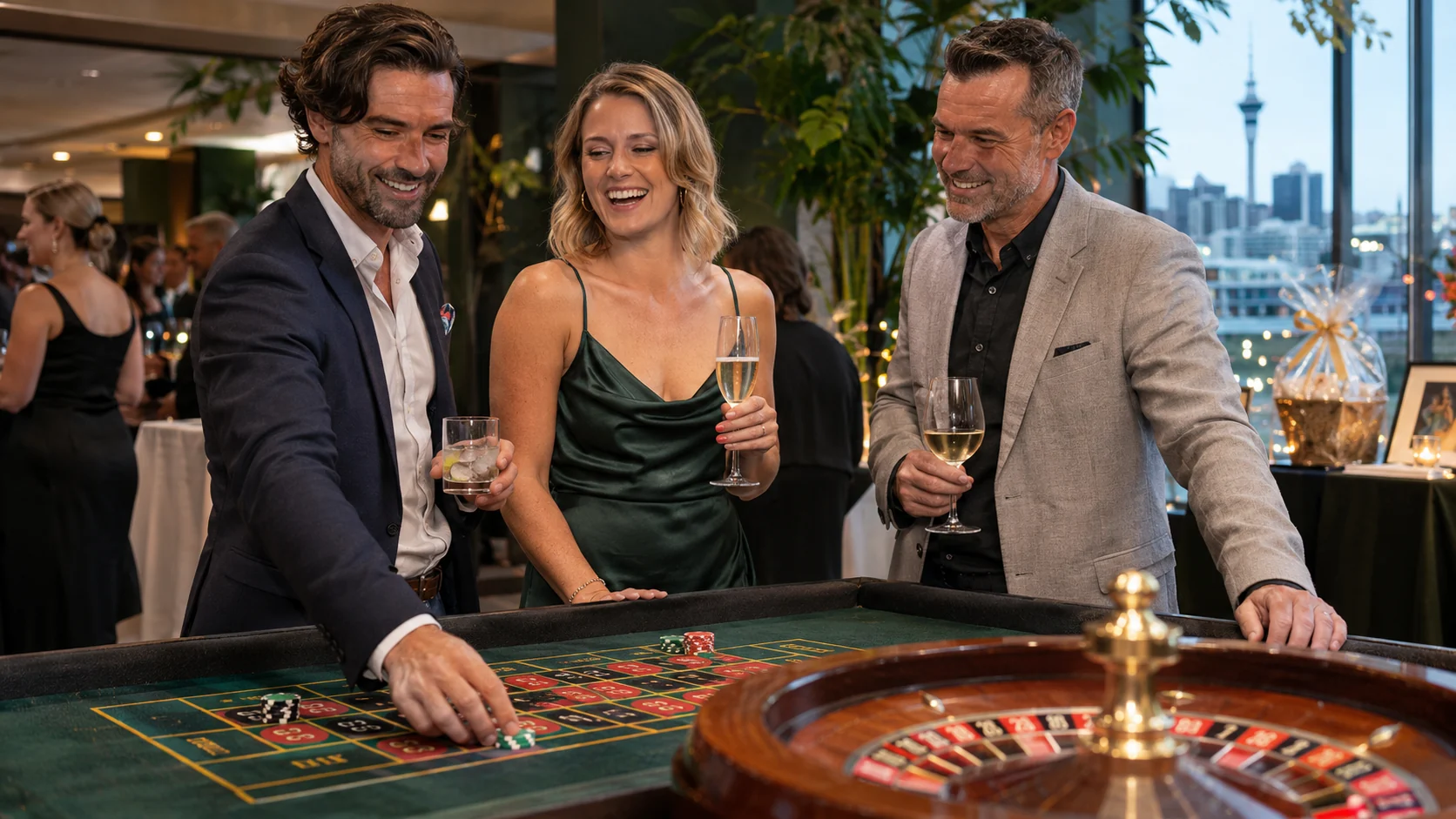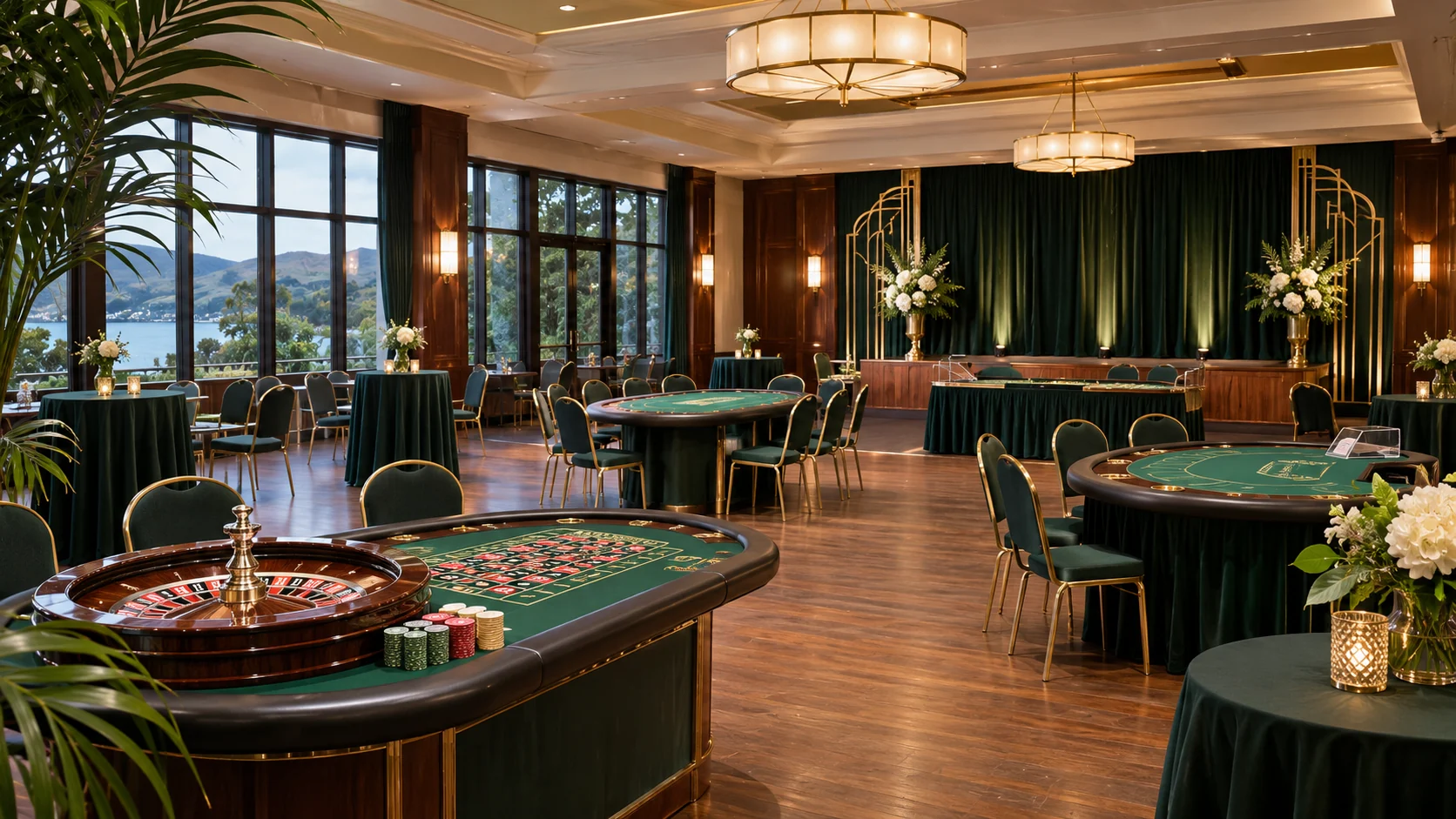
A casino-themed evening can mean three very different things in New Zealand: a night out at a licensed casino, a pop-up casino party using entertainment-only chips, or a dressed-up event inspired by the glamour of Las Vegas, Monte Carlo or the Roaring Twenties. The distinction matters. Guests might be looking for live music and dining, a chance to learn blackjack, or an excuse to wear a tuxedo and pose beside an oversized roulette wheel. Real-money gambling does not have to be part of the occasion.
A dealer who explains the games and a clear programme give guests a way into the evening without requiring them to know casino rules. Props alone do little for someone unsure where to start.
Three ways to experience a casino-themed event
Scroll sideways to view all columns.
| Format | What guests experience | Best fit |
|---|---|---|
| Casino venue night | Bars, restaurants, live performances or casino promotions alongside a licensed gaming floor. | Adults who prefer an established entertainment venue and the option of gaming. |
| Mobile fun-casino party | Roulette, blackjack or poker tables with croupiers, demonstration rounds and chips used for entertainment. | Corporate functions, private celebrations, conference socials and team events. |
| Casino-inspired gala | A black-tie or costume theme, themed dining, music, photo opportunities and optional games. | Awards nights, balls and mixed-interest groups where gaming should remain secondary. |
A mobile casino is not a licensed casino transplanted into a function room. The format is normally designed around social play. That separation should be explicit in invitations, prize rules and the way chips are issued and collected.
Casino themes that change the mood of the night
Viva Las Vegas: bold, playful and high-energy
Las Vegas works when guests expect a lively party rather than a restrained formal dinner. Neon-style signage, a red carpet, velvet ropes, giant dice, jumbo playing cards and a photo booth make the theme immediately recognisable. Roulette and the Money Wheel create movement and an easy spectator experience; a DJ, covers band or cabaret-style act can carry the evening beyond the gaming tables. Black, red and gold are reliable colours, although lighting and a single feature entrance are more effective than covering every surface in casino symbols.
Casino Royale: a black-tie spy story
A James Bond-inspired event favours tailored suits, evening dresses, subdued lighting and a more cinematic arrival. Blackjack, poker and roulette can become scenes in a spy mission, with an MC or character actors providing clues between rounds. New Zealand event programmes have used this format as an interactive dinner experience rather than simply dressing a room as a casino. A spy narrative gives non-players a reason to participate, while a live singer or lounge band supports the atmosphere. For commercial branding, original artwork is safer than assuming film logos or characters are free to reproduce.
Great Gatsby and the Roaring Twenties: Art Deco and jazz
A 1920s setting draws on geometric Art Deco patterns, gold accents, feather centrepieces, pearls, flapper-style fashion and vintage jazz. Prohibition-era speakeasy details, a secret entrance and a theatrical host suit a cocktail or dinner format. A gangster mystery can turn the night into a story: guests meet characters, exchange clues and drift between tables rather than sitting through one continuous show. Casino games are an added activity, not the defining historical feature of the theme.
Monte Carlo: refined gaming and conversation
Monte Carlo suits a smaller reception where the emphasis is on service, conversation and elegant presentation. Deep red or emerald accents, crisp table linen, soft lighting and well-spaced blackjack or roulette tables establish the mood without a crowded stage. A jazz trio or pianist is a better match than constant announcements. The format works particularly well when a seated dinner or cocktail reception is the main event.
Western saloons, masquerades and other variations
Western casino nights can bring together saloon doors, wagon wheels, wanted posters and simple table games. Masquerade and black-and-white themes shift attention towards costumes and dancing. Combining too many ideas weakens the result: a Western saloon and a Monte Carlo gala demand different music, décor and guest behaviour. A single theme should govern invitations, dress code, food presentation and the entertainment schedule.
Where casino culture meets live entertainment in Aotearoa
New Zealand’s casino venues are also hospitality and nightlife destinations. SkyCity Auckland brings together dining, the Sky Tower precinct, casino entertainment, live music and theatre. Its Flare Bar is associated with live performances, while the wider complex offers restaurants and late-night food. SkyCity Hamilton combines casino events with live entertainment, dining and Bowl & Social, giving groups activities beyond the gaming floor.
In the South Island, Christchurch Casino lists local live music, quizzes, sport and special events, including poker competitions. Grand Casino Dunedin offers a particularly clear example of the casino-as-experience model: its Grand Experience combines a guided blackjack or tournament-style session with dining, or a Room118 cocktail masterclass. SkyCity Queenstown adds the Level Two Bar & Lounge and an events programme to its casino setting.
These are not interchangeable experiences. A ticketed performance, a private function, a loyalty promotion and admission to a gaming floor can have different entry conditions and booking arrangements. Event calendars and terms are more reliable than assuming a themed promotion will recur on the same date each year.
Choosing games for the people in the room
Roulette is visually immediate: a spinning wheel gathers a crowd, and guests can learn the basic choices quickly. Blackjack offers short rounds and straightforward dealer-led instruction. Poker, including Texas Hold’em, rewards a longer attention span and a quieter table; a full tournament can dominate the programme if guests are expected to circulate. A Money Wheel is simple enough for casual drop-in play. Crown and Anchor fits a traditional fairground or story-led evening, while baccarat and Caribbean Stud Poker are more specialist choices for groups already interested in casino games.
A common planning mistake is treating every table as having the same capacity. One group can gather around a roulette wheel while only a limited number of people actively play a hand of blackjack or poker. Guest numbers, table seats and the expected length of each round determine whether guests spend time participating or waiting. An experienced croupier can explain the rules in plain English, run practice hands and maintain a comfortable pace.
There are two useful ways to run a fun-casino floor. In an open-play format, guests receive entertainment chips and move between tables whenever they like. In a competition format, players rotate through timed rounds and the final chip tally provides a light-hearted finish. Event companies also use team formats and “Millionaires Night Out” concepts, sometimes issuing novelty gold cards at the entrance. The point is social interaction, not reproducing a high-stakes gambling environment.
Atmosphere comes from the whole event, not only the tables
The arrival sets expectations. A playing-card invitation can establish the dress code; a red-carpet entrance, themed backdrop and photographer give guests something to do before the games begin. Inside, table placement should create clear paths to catering, seating, toilets and exits. Keeping drinks off the gaming felt protects the equipment and makes games easier to run.
Food changes the rhythm of the event. Canapés and grazing tables support roaming play, while a seated meal benefits from a defined pause in the casino session. A cocktail or alcohol-free drinks menu can echo the theme without making drinking a condition of participation. DJs, jazz groups, roving magicians, comedy performers, paparazzi-style characters and an MC work best when each has a specific job: welcome guests, keep transitions smooth, provide a focal performance or open the dance floor.
A practical three-and-a-half-hour programme could run as follows:
- First 30 minutes: arrivals, photographs, food and a short explanation of the evening’s games.
- Next 90 minutes: dealer-led tables, optional mini-challenges and relaxed guest rotation.
- Following 45 minutes: dinner, live entertainment or an interactive mystery reveal.
- Final 45 minutes: a brief game finale, recognition of participants and music or dancing.
That running order is an example rather than a fixed industry standard. A short learn-to-play experience and an all-evening corporate ball require different pacing. People who prefer not to play still need comfortable seating, conversation space and entertainment that makes sense without collecting chips.
Matching the concept to a New Zealand occasion
Corporate and conference events benefit from low-pressure activities with clear instructions. Brief blackjack rounds, roulette and team challenges give colleagues a common point of conversation. A Casino Royale mystery is better suited to a group that enjoys performance and role-play; a Monte Carlo reception is less demanding for clients and senior guests who primarily want to network.
End-of-year and midwinter Christmas functions often need a flexible programme for mixed ages, preferences and levels of enthusiasm. Theming the arrival and entertainment makes it possible to enjoy the party without playing any games. A venue with a separate dance area and enough seating usually serves that audience better than allocating all available floor space to casino tables.
Birthdays, weddings and private parties suit a modest number of well-run tables, especially when speeches, dining or dancing already shape the night. Fundraisers and community functions demand extra care over payment, entry conditions, chip allocation, raffles and prizes. A casino look is not the same as permission to conduct a fundraising gaming session.
What affects the budget and venue choice?
The headline casino-hire fee rarely describes the entire event. Quotes can differ on full-size tables versus tabletop equipment, number of professional dealers, length of play, transport, setup and pack-down, GST, themed props, an MC, photography, prizes, venue hire and catering. Auckland-based event packages demonstrate how a two-table social session and a larger four-table function are distinct products; the appropriate scale follows the guest count and programme, not the most elaborate package name.
For events outside the main centres, travel and equipment logistics deserve early attention. Suppliers work across Auckland, Hamilton, Tauranga, Rotorua, Taupō, Wellington, Christchurch, Dunedin and Queenstown, but service areas and freight costs are not identical. Function rooms need access for moving large tables, sufficient floor space, stable lighting and clear fire exits. Guests also need accessible routes, suitable seating, transport options and dietary choices. A venue’s own noise restrictions or closing time can be more decisive than its decorative potential.
Budget discipline starts by choosing one main attraction. If the goal is conversation, fewer tables and stronger hosting may outperform an oversized casino setup. If guests have travelled for a gala, dining, music and photography deserve funding as well. Checking the inclusions line by line is more useful than comparing package names alone.
Fun-money entertainment, fundraising and New Zealand law
Casino theming is not itself gambling. A social event with decorative chips that cannot be bought, redeemed for cash or exchanged for prizes is different from an activity where participants pay to take a chance at something of value. The legal position turns on how the event actually operates, not whether the organiser calls the chips “fun money”.
New Zealand’s Gambling Act 2003 governs gambling activities. The Department of Internal Affairs identifies gaming sessions, also called casino evenings, among the forms of gambling that can fall within Class 3. Gambling with prizes above NZ$5,000 for a session requires a Class 3 licence and must be run by an eligible society. Other limits and conditions apply to lower classes, and poker nights, raffles or auctions can raise separate questions. A prize’s retail value matters even when the prize is not cash.
For a community fundraiser, the ticket price, who receives chips, whether extra chips can be purchased, the distribution of prizes and the use of proceeds all need to be settled before promotion. Charities Services directs organisations running casino nights and similar activities to their obligations under the Act. An entertainment-only arrangement should not be described as legally exempt without checking its actual structure.
Licensed casino floors have a different set of visitor rules. The minimum age for entering a casino in New Zealand is 20 , and acceptable physical photo identification is required. Casino operators enforce entry and dress standards; SkyCity venues also require an eligible rewards card for gaming. The age limit for a private themed dinner or a non-gambling event does not automatically become 20 merely because the décor features roulette wheels. Anyone attending a real casino can enjoy its dining or performance programme without treating gambling as a necessary part of the night. Free, confidential gambling support is available through New Zealand’s Gambling Helpline on 0800 654 655 .
Questions people ask before a casino-themed night
Do guests have to know blackjack, poker or roulette?
No. A hosted fun-casino event is designed to introduce the rules as people arrive at the tables. Blackjack and roulette are accessible starting points; poker benefits from a longer explanation. A short practice round is more welcoming than assuming every guest already plays.
Is black tie compulsory?
Only when the organiser specifies it. Casino chic, cocktail attire and a black-and-gold dress code offer less formal alternatives. Casino Royale and Monte Carlo naturally support eveningwear; a Wild West or 1920s event works through costume. Licensed venues set their own dress requirements regardless of a themed invitation.
Can the event work without gambling or alcohol?
Yes. Dealer demonstrations, non-redeemable entertainment chips, character-led mysteries, photography, music and themed food can carry an entire evening. Alcohol-free drinks and a programme with activities away from the tables make the experience more inclusive.
What separates a successful theme from a room full of decorations?
Guests can tell where to go, when to join a game and where to talk away from the tables. The music, food and pace then match the chosen theme, whether it is Vegas, Gatsby or a corporate casino night.