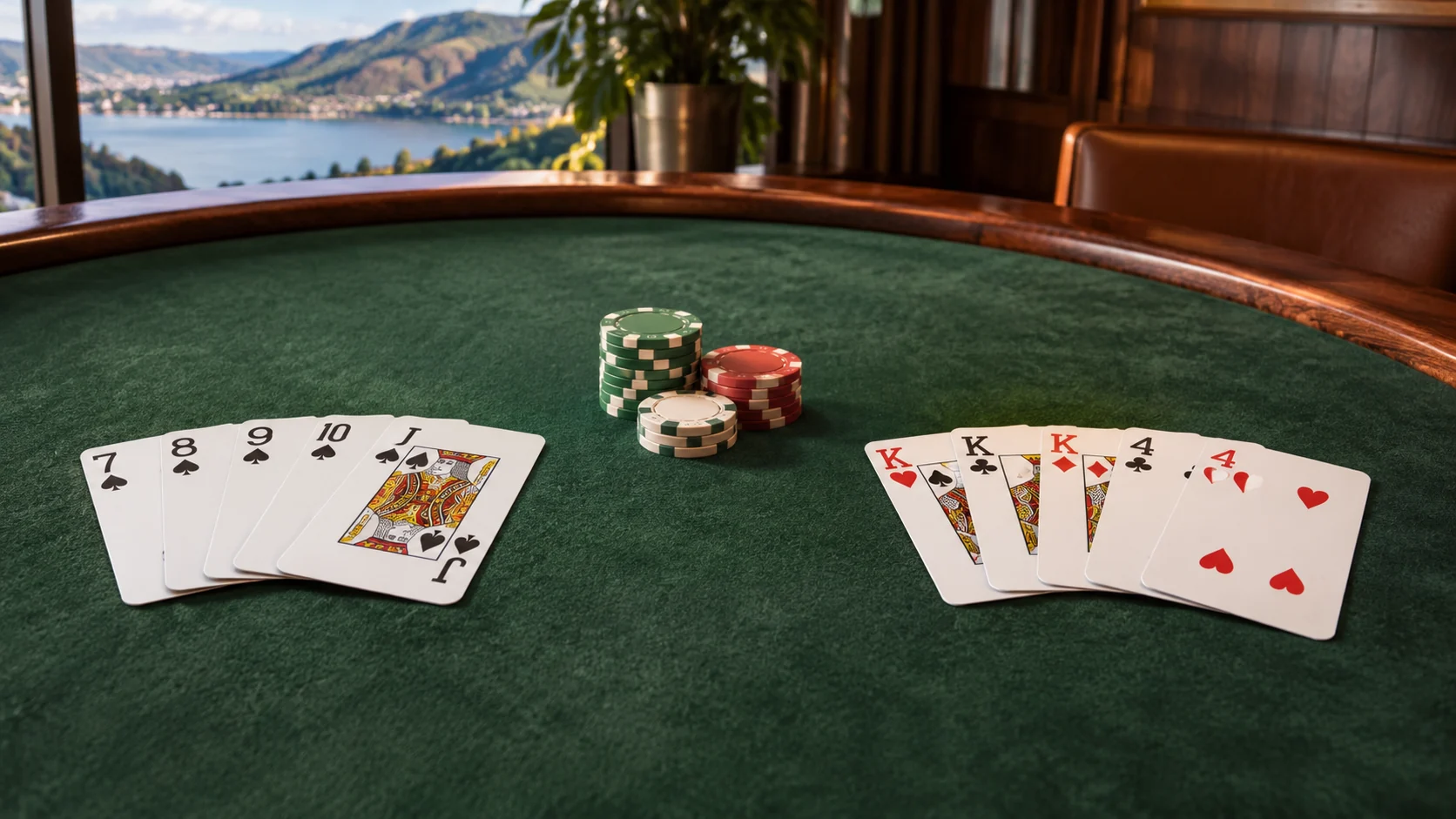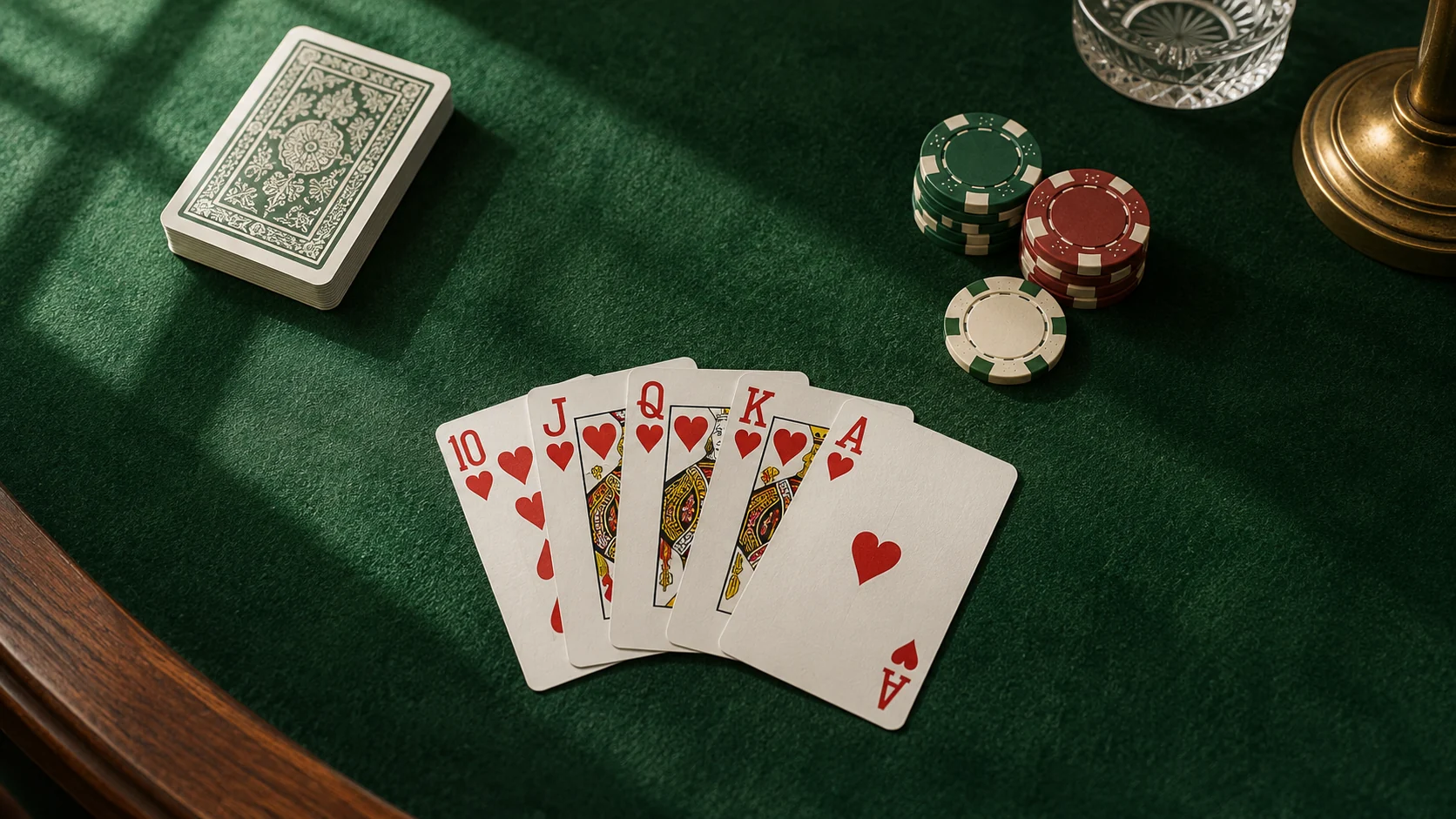
In standard high poker, a royal flush ranks first and high card last. Only a player’s best five-card hand counts. The category decides first; matching categories are separated by card ranks. Suits never break a tie in Texas Hold’em.
At a New Zealand poker club, A-A can lose to two low pairs. A flush beats a straight, and equal five-card hands split the pot even when the hole cards differ.
Poker hands in order: strongest to weakest
Standard rankings assume a 52-card deck without wild cards. Each category beats those below it. The royal flush is the highest straight flush, traditionally shown separately on the ten-hand chart.
Scroll sideways to view all columns.
| Rank | Poker hand | Five-card example | What makes it |
|---|---|---|---|
| 1 | Royal flush | A♠ K♠ Q♠ J♠ 10♠ | Ten to ace, all one suit |
| 2 | Straight flush | 9♥ 8♥ 7♥ 6♥ 5♥ | Five consecutive cards of one suit |
| 3 | Four of a kind | Q♣ Q♦ Q♥ Q♠ 7♠ | Four cards of the same rank |
| 4 | Full house | J♦ J♣ J♠ 8♣ 8♥ | Three of one rank plus a pair |
| 5 | Flush | A♦ J♦ 9♦ 6♦ 3♦ | Five cards of one suit, not consecutive |
| 6 | Straight | Q♥ J♣ 10♦ 9♠ 8♥ | Five consecutive ranks |
| 7 | Three of a kind | 8♠ 8♥ 8♦ K♣ 2♠ | Three cards of the same rank |
| 8 | Two pair | A♣ A♥ 5♣ 5♦ Q♠ | Two distinct pairs and one side card |
| 9 | One pair | 10♦ 10♣ K♠ 7♦ 4♥ | One pair and three side cards |
| 10 | High card | A♥ Q♦ 9♣ 6♠ 3♥ | No pair or stronger combination |
From highest to lowest, card ranks run A, K, Q, J, 10 down to 2. Spades (♠), hearts (♥), diamonds (♦) and clubs (♣) have equal standing. Five red cards do not make a flush unless they are all hearts or all diamonds.
What each poker hand means
1. Royal flush
A-K-Q-J-10 in one suit is the best possible hand. It needs no kicker. If those five cards appear on the Hold’em board, everyone still contesting the pot plays the same royal flush.
2. Straight flush
Five consecutive cards of the same suit make a straight flush. The top card decides which is higher: a 10-high straight flush beats a 9-high one. A-2-3-4-5 counts as 5-high with the ace low. The run cannot wrap around; Q-K-A-2-3 does not qualify.
3. Four of a kind (quads)
Four cards of one rank are called quads. Four kings beat four queens, whatever the side card. A kicker matters only when both players have identical quads, as they can when all four lie on the Hold’em board.
4. Full house (boat)
K-K-K-4-4 is a full house, spoken as “kings full of fours”. Compare the three-card rank before the pair. Kings full of fours beat queens full of aces (Q-Q-Q-A-A); the aces cannot rescue the lower trips.
5. Flush
Five cards of one suit make a flush, unless they form a straight flush. Compare the highest suited card, then work down through the remaining four. An ace-high flush beats a king-high flush; there is no sixth-card kicker.
6. Straight
Five consecutive ranks make a straight unless all cards share a suit. A-K-Q-J-10 is Broadway , the highest straight. A-2-3-4-5 is the wheel or baby straight , with the ace low; six-high beats it. K-A-2-3-4 is not a straight.
7. Three of a kind (trips or a set)
Three matching ranks plus two unmatched cards make three of a kind. Hold’em players call it a set when a pocket pair finds its third card on the board, and trips when a hole card matches a board pair. The ranking is identical. Compare the three-card rank, then the two kickers.
8. Two pair
For two pair, compare the higher pair first, then the lower, then the kicker. A-A-2-2-K beats K-K-Q-Q-A because aces outrank kings. With three different pairs among seven cards, use the two highest pairs and the strongest remaining card.
9. One pair
One pair consists of two matching ranks plus three other cards. Queens beat jacks; equal pairs are settled by three kickers from highest to lowest. Pocket aces (A-A) are a premium starting hand , not a guaranteed winner at showdown.
10. High card
Without a pair, straight, flush or stronger combination, compare the five cards from highest down. A-high beats K-high; ties on the top card are broken by the next. High card can still take a pot against a weaker hand.
How to work out who wins at showdown
At a close showdown, start with each player’s best legal five cards, not the biggest-looking hole card.
- Check the game. Hold’em allows any five cards from seven available. Omaha requires exactly two hole cards and exactly three community cards.
- Build the best five. Extra pairs, a sixth suited card or an unused ace do not strengthen a completed five-card combination.
- Compare categories. A straight always beats three of a kind in standard Hold’em, even if the three matching cards are aces.
- Apply the tie-break rule. Compare the ranks that define the hand first, then the relevant remaining cards.
- Split genuinely equal hands. If both players’ best five cards have identical ranks, neither suit nor an unused sixth card can break the tie.
Which cards break a tie?
| Hand | Compare in this order |
|---|---|
| Royal flush | Always equal in rank; split if both players have one |
| Straight flush | Highest card of the five-card sequence |
| Four of a kind | Rank of the quads, then the fifth card |
| Full house | Rank of the three of a kind, then rank of the pair |
| Flush | Highest flush card, then the next four in descending order |
| Straight | Highest card of the sequence; no kicker |
| Three of a kind | Rank of the trips, then both kickers |
| Two pair | Higher pair, lower pair, then kicker |
| One pair | Rank of the pair, then all three kickers |
| High card | All five cards, highest to lowest |
Kicker example: the same pair, different winner
Board: K♠ K♦ 9♣ 5♥ 2♠. Player A: A♣ Q♣. Player B: A♦ J♦. Both have kings with an ace kicker. Player A’s K-K-A-Q-9 beats Player B’s K-K-A-J-9: the queen, not the suit, settles it.
Playing the board: a genuine split pot
Board: A♠ K♦ Q♣ J♥ 10♠. Player A: 2♣ 2♦. Player B: 4♣ 4♦. The board itself makes Broadway. Both players use A-K-Q-J-10; their pocket pairs cannot improve it, so the pot splits.
Ace-high flush versus ace-high flush
Board: A♥ J♥ 7♥ 4♥ 2♣. Player A: K♥ 3♣. Player B: Q♥ 9♣. Both hold an ace-high heart flush, but A-K-J-7-4 beats A-Q-J-7-4. The king is part of the flush, not an outside kicker.
A fold can award a pot before showdown. When players are all-in for different amounts, main and side pots may form; only eligible players contest each one. Under Poker Tournament Directors Association procedures, properly tabled cards speak for themselves. The club’s rules and tournament director settle procedural disputes.
What beats what in the closest match-ups?
- Does a flush beat a straight?
- Yes. A flush beats a mixed-suit straight; a straight flush beats both.
- Does a full house beat a flush?
- Yes in standard 52-card poker, even against an ace-high flush.
- Does a straight beat three of a kind?
- Yes. Even a 5-high straight beats three aces. Check Short Deck rules separately.
- Does three of a kind beat two pair?
- Yes. Three twos beat aces and kings as two pair.
- Does four of a kind beat a full house?
- Yes. Only a straight flush, including a royal flush, beats quads.
How poker hands work in Hold’em, Omaha and other games
Texas Hold’em: zero, one or two hole cards can play
Texas Hold’em deals two private hole cards per player, then five community cards in stages: flop (three), turn (one) and river (one). Make the best five from those seven, using both hole cards, one or neither. Pre-flop means before the community cards appear.
Omaha and Pot-Limit Omaha: exactly two plus three
In four-card Omaha, including standard Pot-Limit Omaha (PLO), each player receives four hole cards. A player must use exactly two plus exactly three community cards. Four hearts on the board and one heart in your hand do not make a flush; the second hole card would also need to be a heart. Hand rankings stay the same, but strong combinations occur more often.
Seven-Card Stud and Five-Card Draw
Seven-Card Stud chooses the best five of seven cards dealt to a player, without a shared board. In Five-Card Draw, players start with five private cards and replace cards under the draw rules. Both use standard high-hand rankings.
Short Deck, lowball and wild-card exceptions
Short Deck , also called 6+ Hold’em , removes ranks two through five, leaving 36 cards. A flush usually beats a full house. The lowest straight runs A-6-7-8-9. Some formats also change the order of a straight and three of a kind, so check the event’s rules.
In Razz and ace-to-five lowball, low cards win; straights and flushes do not count against the low hand. Deuce-to-seven lowball treats aces as high and counts straights and flushes against the player. Its best hand is 7-5-4-3-2 of mixed suits. Omaha Hi/Lo can divide the pot between a high winner and a qualifying eight-or-better low hand. Badugi rewards up to four low cards of different ranks and suits. Wild-card games may permit five of a kind. Those rules do not apply to an ordinary Hold’em club tournament.
Poker hand probabilities: five cards versus seven
There are 2,598,960 five-card combinations from a 52-card deck and 133,784,560 seven-card selections. A royal flush occurs in just four of the five-card combinations: once in 649,740. With seven available cards, it occurs roughly once in 30,940. Extra cards change how often a category appears, not where it ranks.
Scroll sideways to view all columns.
| Best hand | Exactly five cards | Best five out of seven (Hold’em by river) |
|---|---|---|
| Royal flush | 0.000154% | 0.0032% |
| Straight flush (not royal) | 0.001385% | 0.0279% |
| Four of a kind | 0.0240% | 0.168% |
| Full house | 0.1441% | 2.60% |
| Flush (not straight flush) | 0.1965% | 3.03% |
| Straight (not straight flush) | 0.3925% | 4.62% |
| Three of a kind | 2.1128% | 4.83% |
| Two pair | 4.7539% | 23.5% |
| One pair | 42.2569% | 43.8% |
| High card | 50.1177% | 17.4% |
The percentages count each completed category once, excluding stronger hands. They are not win probabilities or odds for a particular starting hand. The seven-card figures cover all possible selections equally; they do not account for opponents, betting action or exposed cards.
High card accounts for just over half of five-card draws. Among seven-card sets, one pair is most common; two pair also occurs more often than high card. In a traditional full deck, a flush is rarer than a straight and ranks above it.
Starting hands are not the same as completed poker hands
“Best poker hands” can also mean pre-flop starting cards. In No-Limit Texas Hold’em, A-A is the strongest pocket pair; K-K and Q-Q are also premium. Suited A-K ( Big Slick , written AKs) can make the nut flush, while J♠ 10♠ offers straight and flush possibilities. The s in AKs means suited; o in AKo means offsuit.
Pre-flop position, betting action, player count and opponents’ likely ranges all affect decisions with A-A. Once community cards arrive, pocket aces can still finish as one pair and lose to any two pair or higher category.
A paired board can produce full houses; three board cards of one suit give flush possibilities; connected ranks open up straights. The nuts are the strongest hand possible on the current board. A nut flush beats every other flush but may lose to a full house on a paired board.
Made hands, draws and outs
A made hand already qualifies for a completed category; a draw needs another card. Four suited cards give a flush draw, while four consecutive ranks can give an open-ended straight draw. A flush draw on the flop usually has nine remaining suited cards, called outs . With 47 unseen cards, it completes by the river about 35% of the time if both cards are dealt and all nine outs remain available. Making a flush is not the same as winning the pot. Pot odds compare the cost of continuing with the pot available, not with the ranking chart.
Common mistakes at a poker club table
- Counting more than five cards: even with six suited cards or three pairs, only the best five count.
- Ranking suits: spades do not beat hearts; equal five-card hands split.
- Calling a draw a made hand: four cards of a suit are not a flush.
- Misreading Omaha: exactly two hole cards must play.
- Comparing the wrong part of a full house: kings full beat queens full, whatever the pairs.
- Trusting pre-flop strength at showdown: the final five cards decide the hand.
Poker hands: practical questions
Can two players have the same royal flush?
Yes. If all five cards of a royal flush are on the board, every remaining Hold’em player shares it. Two different-suit royal flushes cannot occur in a single standard Hold’em deal.
Can a kicker beat a straight or a flush?
No. Equal straights tie by their high card; flushes use all five suited ranks. An unrelated sixth or seventh card cannot break either tie.
Is an ace high or low?
An ace ranks above a king, except at the low end of A-2-3-4-5. It never sits in the middle or wraps a straight from king to two.
What happens if the dealer announces the wrong hand?
Tabled cards determine the winning hand, not a dealer’s mistaken announcement. Keep your cards identifiable until the pot is awarded, and flag an error immediately. Tournament staff apply the event’s rules to disputes.