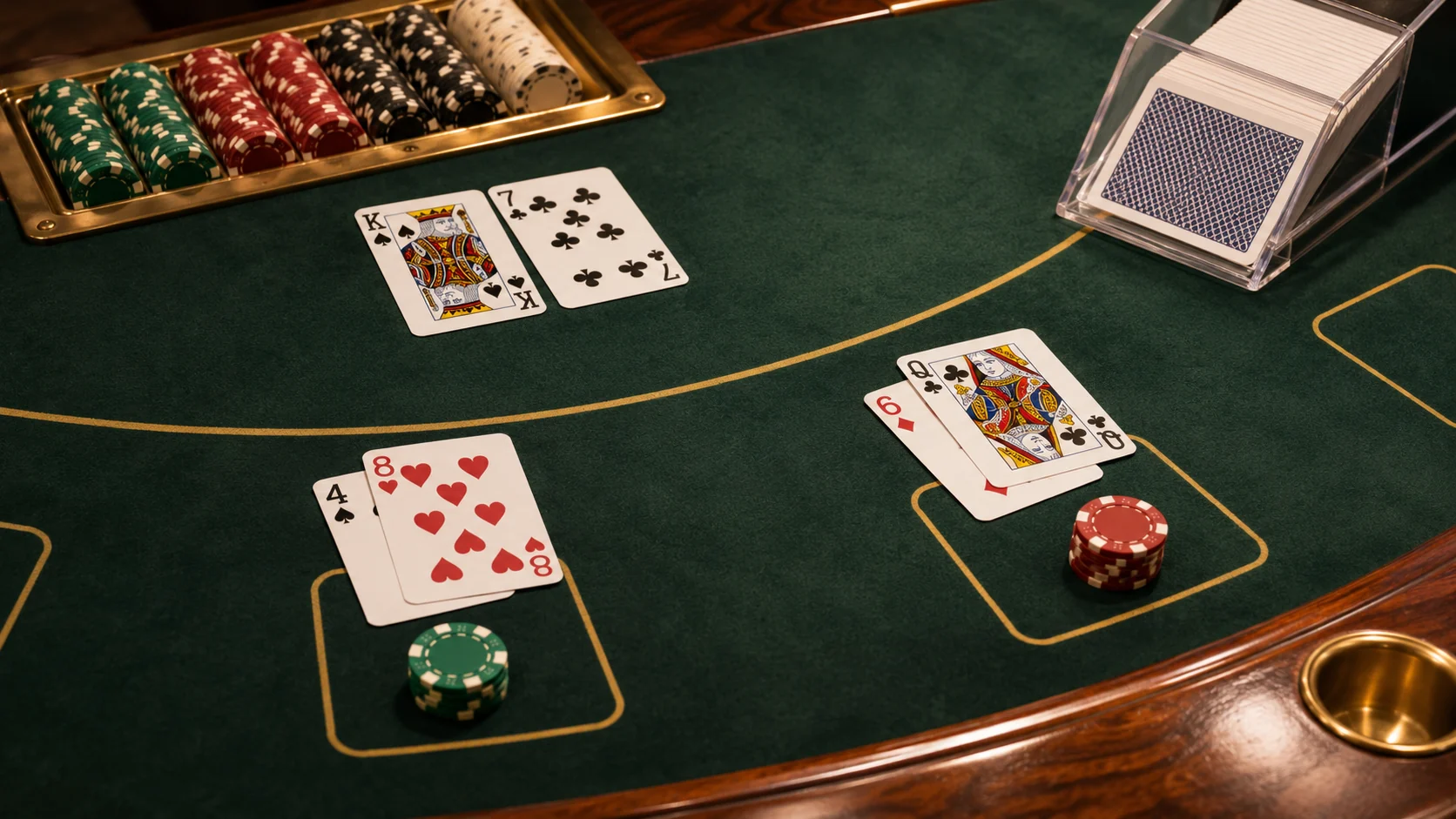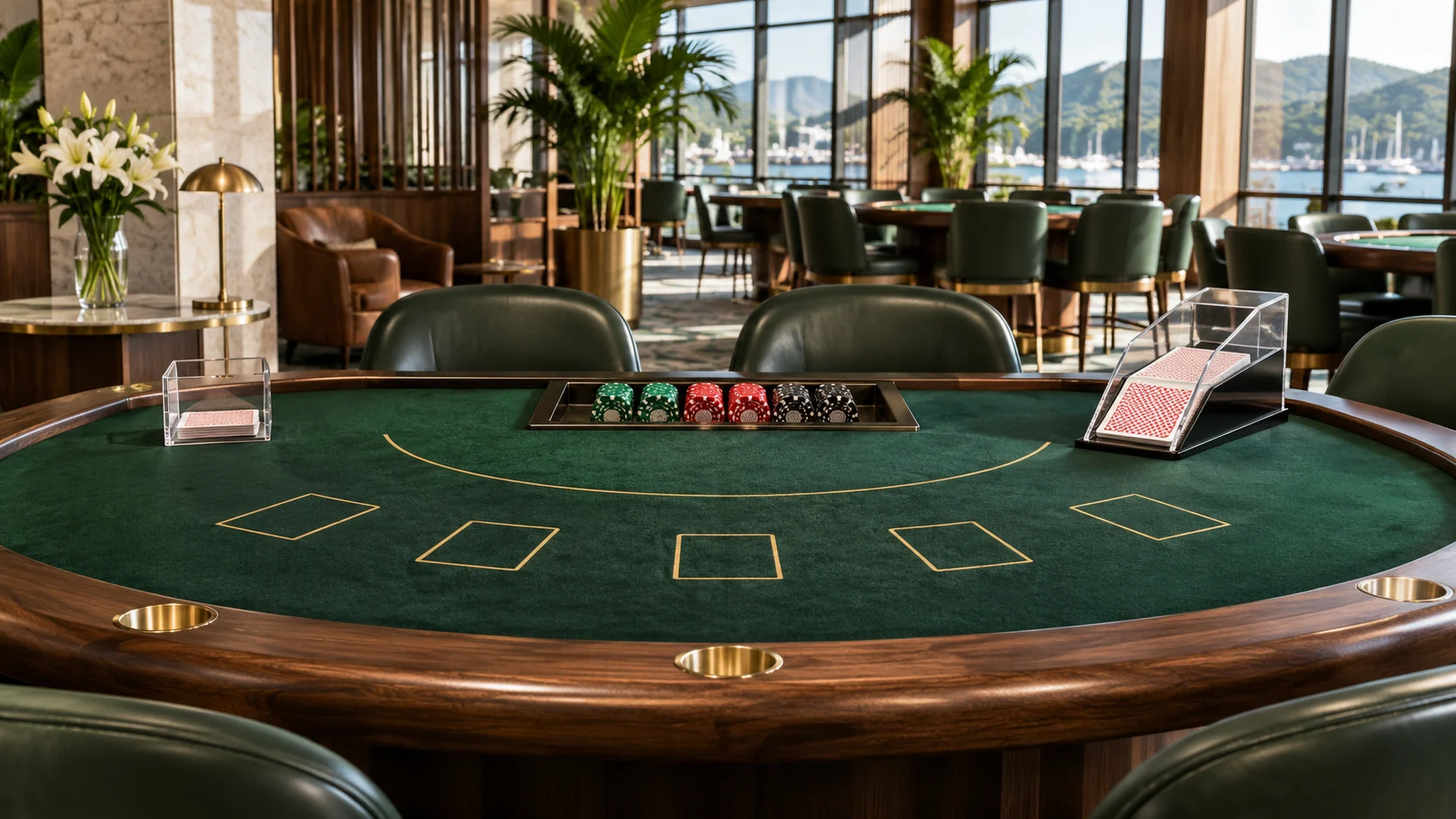
Blackjack is played against the dealer, not the other players. The aim is to finish closer to 21 than the dealer without going over. An 18 can beat 17; 20 loses to 21; equal totals push. Players choose how to play their hands, while the dealer follows fixed drawing rules.
Two blackjack tables can look identical and pay very differently. A natural blackjack worth 3:2 beats one paying 6:5, and the dealer’s soft-17 rule, splitting restrictions and treatment of extra stakes can shift the house edge further. Those conditions matter more than table artwork or an advertised bonus.
Blackjack at a glance
Scroll sideways to view all columns.
| Feature | Standard blackjack | What changes between tables |
|---|---|---|
| Objective | Beat the dealer with a total of 21 or less | Special variants can alter how a dealer bust is settled |
| Cards | 2–10 at face value; J, Q and K worth 10; Ace worth 1 or 11 | Usually several 52-card decks; Spanish 21 removes the tens |
| Natural blackjack | Ace plus a ten-value card as the first two cards | Common payouts are 3:2 or 6:5 |
| Player actions | Hit, stand, double down and split | Surrender, double-after-split and re-splitting may be restricted |
| Dealer action | Draws under 17; follows a fixed rule at 17 | Dealer stands on soft 17 (S17) or hits soft 17 (H17) |
| Ordinary win | Usually 1:1 profit; a tie is a push | Natural wins, side bets and variant payouts have separate rules |
| Where it is played | Physical casino, RNG game or live-dealer table | Availability, minimum bets, speed and local legal status differ |
Check the natural-blackjack payout, the dealer’s soft-17 rule, whether doubling after a split is allowed, and what happens to extra wagers if the dealer reveals blackjack late. A low minimum bet tells you only the size of the opening stake.
How blackjack works
Card values and hand totals
Cards 2–10 count at face value. Jacks, queens and kings are face cards worth ten each. An Ace counts as eleven unless that would bust the hand, when it counts as one. Suits do not change the total.
A hand is soft while an Ace still counts as eleven. Ace–6 is soft 17: if a ten arrives, the Ace switches to one and the total remains 17. Ten–7 is hard 17 . So is Ace–6–10, because its Ace must count as one.
An Ace and a king on the initial deal make a natural blackjack . The three-card combination 7–5–9 also totals 21, but it normally pays as an ordinary win. A 21 formed after splitting Aces is usually not a natural either; its payout follows the split-hand rules.
One round, from first bet to settlement
- Place the initial wager. A physical blackjack table uses chips in marked betting boxes; a digital table shows an electronic stake and betting limits. Some tables permit multiple occupied boxes or positions.
- Receive the opening cards. The player normally receives two cards. The dealer shows an upcard ; an American-style game may also deal a face-down hole card . A European no-hole-card game uses a different dealing procedure.
- Check for a natural. The dealer’s peek or blackjack check, if provided, can settle certain hands before player decisions. An Ace upcard may trigger an insurance offer.
- Choose an action. Hit for another card, stand on the present total, or use a permitted double, split or surrender option. Every split hand is played and settled separately.
- Resolve the dealer’s hand. After the surviving players finish, the dealer follows the table’s compulsory drawing rule. A total over 21 is a bust .
- Settle each wager. Higher surviving player totals win, lower totals lose and equal totals push. Natural blackjacks and separate side bets follow their own paytables.
Take a NZ$10 hand of hard 12 against the dealer’s 6. Under a common multi-deck basic-strategy chart, the player stands. Suppose the dealer turns up a ten, reaching 16, then draws an eight and busts at 24. The player makes NZ$10 profit and receives NZ$20 including the original stake. A dealer finishing on 17–21 would have produced a different result.
Every hand faces the dealer separately. Another player can change which card comes next from a shared shoe, but their decision provides no reliable prediction and cannot establish who was responsible for a loss.
Hit, stand, double, split and surrender
- Hit
- Take one additional card. More hits are normally allowed while the hand has not busted or been closed by another action.
- Stand
- Keep the current total and finish the player’s turn. A strong total such as hard 19 is normally stood on.
- Double down
- Increase the wager, commonly by an amount equal to the first stake, and receive exactly one final card. Some venues restrict eligible totals, forbid doubling on soft hands or allow only a specified additional amount.
- Split
- Divide an eligible starting pair into two hands by placing another wager. Each hand receives another card. Rules determine whether further splits, doubling after split (DAS) or drawing to split Aces is permitted.
- Surrender
- Forfeit part of the initial bet, normally half, instead of playing the hand to completion. Early surrender and late surrender differ in their timing relative to the dealer’s blackjack check.
- Insurance
- A separate wager offered when the dealer shows an Ace. Conventional insurance pays 2:1 if the dealer has a natural blackjack; it does not change the main hand’s cards.
Doubling and splitting put additional money at risk. After taking a third card, a player normally cannot double that hand; split Aces may receive only one extra card each. Physical casino tables in New Zealand also use hand signals, with permitted moves set by the venue’s rules.
Blackjack payouts: why 3:2 beats 6:5
Payout ratios refer to profit, not the return of the original chip. At 3:2 , a winning natural earns NZ$1.50 profit for each NZ$1 bet. At 6:5 , it earns NZ$1.20. An ordinary winning hand typically pays 1:1.
Scroll sideways to view all columns.
| Outcome on a NZ$20 main bet | Profit or loss | Total amount returned |
|---|---|---|
| Natural blackjack paid 3:2 | +NZ$30 | NZ$50 |
| Natural blackjack paid 6:5 | +NZ$24 | NZ$44 |
| Ordinary winning hand paid 1:1 | +NZ$20 | NZ$40 |
| Push, or stand-off | NZ$0 | NZ$20 |
| Loss or bust | −NZ$20 | NZ$0 |
| Surrender with half-stake refund | −NZ$10 | NZ$10 |
Reducing the natural payout from 3:2 to 6:5 increases the house edge by about 1.39 percentage points , with other standard rules unchanged. A two-card 21 after splitting, a three-card 21 and a natural may settle differently. The paytable decides, not the number 21 alone.
Even money is an offer sometimes made when a player has a natural and the dealer shows an Ace. The player accepts 1:1 profit regardless of whether the dealer has blackjack. It is mathematically equivalent to insuring the natural, not a free additional prize.
The table rules that affect the house edge
The house edge measures the casino’s theoretical advantage over many wagers, assuming a particular strategy and rule set. Return to player (RTP) is the complementary long-run percentage: a 0.5% house edge corresponds to 99.5% RTP. Either figure says little about the outcome of one session.
A house edge near 0.5% assumes favourable rules and accurate basic strategy. Restrict doubling, alter the dealer’s drawing rule or cut the natural payout, and that estimate no longer applies.
| Rule to read | Why it matters |
|---|---|
| 3:2 or 6:5 natural | The single payout change can add roughly 1.39 percentage points to the house edge. |
| S17 or H17 | A dealer who hits soft 17 gives the house roughly 0.2 percentage points more advantage, all else equal. |
| Deck count | Single-, double-, four-, six- and eight-deck games have different card distributions. Fewer decks are not automatically better if the payout or other conditions deteriorate. |
| Double restrictions | Doubling any opening two cards, only hard 9–11, or only 10–11 changes the available strategy. |
| DAS and re-splitting | Doubling after a split and creating additional split hands affect expected return and maximum round exposure. |
| Dealer hole card or ENHC | Dealer peek, European no-hole-card (ENHC) and an original-bets-only rule determine which extra wagers are at risk against dealer blackjack. |
| Surrender | A permitted half-loss option can improve the expected result of selected weak hands. |
| Side bets or special payouts | Perfect Pairs, 21+3 and other features have their own odds and may not share the main game’s RTP. |
At an S17 table, the dealer stands on a soft 17. At an H17 table, the dealer draws another card. That changes expected return and can alter individual basic-strategy decisions.
European no-hole-card games deserve a close look before doubling or splitting. If a dealer blackjack is revealed only after those moves, some versions take the extra bets as well as the original. Under an original bets only (OBO) rule, qualifying extra stakes are returned. The name “European Blackjack” does not settle which procedure applies.
Basic blackjack strategy without guesswork
Basic strategy selects the action with the best expected value for a given hand, dealer upcard and set of rules. It does not predict the next card. A matching chart distinguishes hard totals , soft totals and pairs , then indicates when to hit, stand, double, split or surrender.
A multi-deck strategy chart for 3:2 blackjack is not universal. S17 versus H17, double after split (DAS), surrender availability and dealer-blackjack settlement can change the correct play at the edges.
Scroll sideways to view all columns.
| Player hand | Dealer upcard | Typical basic-strategy action |
|---|---|---|
| Hard 8 or less | Any | Hit |
| Hard 9 | 3–6 | Double if permitted; otherwise hit |
| Hard 10 | 2–9 | Double if permitted; otherwise hit |
| Hard 11 | 2–10 | Usually double; the correct action against an Ace varies by rules |
| Hard 12 | 4–6 | Stand; hit against 2–3 or 7–Ace |
| Hard 13–16 | 2–6 | Usually stand; hit against 7–Ace unless a better surrender or pair play applies |
| Hard 17 or more | Any | Stand |
| Soft 18 (Ace–7) | 3–6 | Often double if allowed; other upcards require the matching chart |
| Pair of Aces or 8s | Any | Normally split, subject to rule-specific surrender exceptions |
| Pair of 5s or ten-value cards | Any | Do not split under standard basic strategy |
The dealer’s upcard changes the calculation. A visible 4, 5 or 6 is more likely to end in a dealer bust than 9, 10 or Ace. Standing on a modest total can then beat drawing another card. No card is ever “due”.
Insurance usually costs the basic-strategy player money. To break even at a 2:1 payout, the dealer must have a ten-value hole card more than one-third of the time. Ten-value cards make up less than one-third of a fresh standard deck. Without a useful count of the remaining cards, declining insurance has the better expected value.
Card counting tracks changes in the proportion of high and low cards left in a shared shoe. Hi-Lo is one such system; it cannot identify the next card. Shallow shoe penetration, continuous shuffling machines and house restrictions limit its usefulness, and a fresh RNG shuffle removes the relevant history. A Martingale betting progression is different: it raises stakes after losses without improving the odds of the next decision, and losses can climb quickly.
Which type of blackjack fits the game you want?
Variant names do not specify the whole game. Spanish 21 changes the deck, Blackjack Switch changes how two hands can be played, and European and American versions often deal with the hole card differently. Payouts and settlement rules remain decisive.
Scroll sideways to view all columns.
| Game type | Distinguishing feature | Main comparison point |
|---|---|---|
| Classic Blackjack | Conventional dealer-versus-player game | Natural payout, S17/H17, deck count and double/split rules |
| American / Atlantic City / Vegas Strip | Often use a dealer hole card and familiar US-style rule families | Peek procedure, number of decks, surrender and payout |
| European Blackjack | Often begins without a dealer hole card | Whether a later dealer blackjack takes doubles and split stakes |
| Spanish 21 | Uses Spanish decks without the rank-ten cards and adds special player rules | Non-standard bonuses and a dedicated strategy chart |
| Blackjack Switch | Two simultaneous hands allow a switch of second cards | Modified natural payout and special dealer-22 settlement |
| Free Bet Blackjack | Certain doubles or splits are funded through a free-bet mechanism | Dealer push-on-22 rule and variant-specific edge |
| Pontoon | A related casino card game with distinctive terminology and rules | Exact rank, action and payout schedule; not ordinary blackjack |
| Multi-hand Blackjack | Several player positions run in one round | Total exposure across all active hands |
Perfect Pairs , Any Pairs and 21+3 are side bets on particular opening-card combinations, not on beating the dealer. Each has its own payout ladder and house edge. A large top prize is only one part of that calculation; the frequency of winning combinations matters too.
Live dealer, online RNG and free blackjack
RNG blackjack deals through software using a random number generator. Rounds can move quickly, and the player makes decisions without a live croupier. Rules and payout information belong to the specific game version, not to every game marked “RNG”.
Live dealer blackjack shows a physical table and croupier by video. Players act within a betting window, so latency, available seats and decision time can matter. Although bets are placed through a screen, the cards come from a live game rather than a software-dealt RNG hand.
Free blackjack , or demo mode , uses credits with no cash value. It lets players practise totals, split controls and settlement without staking money. A real-money version may use different rules despite looking identical. Browser and app options on iOS or Android also differ by provider.
Faster tables can turn over more money in the same hour. RNG blackjack often deals more rounds than a live table; even a small stake adds up when the bet is placed repeatedly. Table speed belongs alongside minimum wagers in a cost comparison.
Blackjack in New Zealand: physical casinos and online rules
Physical blackjack in New Zealand operates under the Gambling Act 2003 and approved table-game rules. The Department of Internal Affairs says patrons must be at least 20 years old to enter a physical casino . Individual venues specify betting limits, permitted doubles and splits, signals and dealing procedures.
Online casino gambling is governed by the Online Casino Gambling Act 2026 , in force from 1 May 2026 . As at 12 November 2026 , New Zealand is still introducing its licensing scheme, with the fully licensed market expected in 2027. Applying for a licence does not mean an operator already holds one. Online casino gambling advertising remains prohibited during the transition.
Operators that served New Zealand before 1 May 2026 may continue temporarily only within the Act’s transitional conditions. From 1 December 2026 , an operator that has not applied for a licence must stop serving New Zealand customers; applicants remain subject to the applicable temporary exemptions while decisions are pending. Up to 15 licences are provided for, with a public register expected as licences are issued. The online system requires 18-plus age verification, unlike the 20-plus rule for entry to physical casinos.
The Department of Internal Affairs (DIA) publishes current player guidance and licensing information. An offshore licence, NZ$ payment option or positive affiliate review is not proof of a New Zealand online licence. A physical casino licence is not an online licence either.
Costs beyond the main blackjack stake
A NZ$10 minimum is commonly charged per hand . Three betting boxes at that stake mean NZ$30 before anyone doubles or splits. Extra hands, insurance and side bets raise the amount exposed in a single round.
A starting bankroll and total turnover are different things. One hundred NZ$10 hands create NZ$1,000 in base wagers, excluding any extra stakes. At a hypothetical 0.5% house edge, that turnover carries NZ$5 in long-run expected cost, not a promised NZ$5 session loss. Short-run swings can be much bigger, including losing the available bankroll.
Online terms add costs unrelated to the cards: account currency, NZD conversion fees, payment ownership rules, identity checks, withdrawals and limits. Some bonuses exclude blackjack or give it a low wagering contribution . At 30x wagering with a 10% blackjack contribution, each NZ$1 of the applicable bonus requires NZ$300 of eligible blackjack stakes if no other play qualifies. The contribution rule matters more than the headline bonus.
Bankroll management limits spending; it cannot change the house edge. A set money limit, a session time limit and refusing to chase losses have more practical value than increasing the next bet after a loss. A run of losses does not make the following hand more likely to win.
Responsible play and support in Aotearoa
Good decisions can reduce blackjack’s expected cost, but chance still controls individual outcomes. Fast rounds and repeated deposits can make losses accumulate before they feel serious. Gambling does not deliver dependable income.
Safer Gambling Aotearoa explains gambling harm and ways to limit it. New Zealand’s free, confidential Gambling Helpline operates 24 hours a day on 0800 654 655 , with free text support on 8006 . Help is also available for whānau affected by another person’s gambling.
Blackjack questions answered
Is blackjack the same as 21?
Yes. Blackjack is also called 21. A natural blackjack , though, specifically requires an Ace and a ten-value card in the opening two-card hand.
Do you have to reach 21 to win?
No. Seventeen can win if the dealer busts. A player who goes over 21 loses even if the dealer later busts too.
Is a 3:2 table better than a 6:5 table?
Yes, all other rules equal. A NZ$10 natural earns NZ$15 at 3:2 but only NZ$12 at 6:5.
Should the dealer hit on soft 17?
S17 means the dealer stands on soft 17; H17 requires another card. With other rules equal, S17 normally favours the player.
Does basic strategy guarantee winning blackjack?
No. It reduces expected losses under specified rules, but variance remains. Betting progressions cannot guarantee a profit.
What is the difference between blackjack and poker?
In blackjack, each hand faces the dealer. Poker usually involves opponents playing one another or payouts set by a separate paytable.
Can blackjack be played for free?
Yes, through a demo or virtual-credit mode. There are no cash prizes, and the rules may differ from the real-money game.
Can card counting beat online blackjack?
Not in independently shuffled RNG games. Live shoe games may provide usable count information, subject to penetration and shuffling practices.
Is online blackjack legal in New Zealand?
The Online Casino Gambling Act 2026 is introducing licensing in stages through 2027. Each operator’s legal position depends on its transitional and licence status; DIA publishes current guidance.
What age applies to blackjack in New Zealand?
Physical casino entry requires age 20 or over. New Zealand’s online casino licensing framework sets an 18-plus participation threshold.